Showing posts with label seminars. Show all posts
Showing posts with label seminars. Show all posts
Wednesday, December 5, 2012
Dan Pink’s Drive
If you haven’t seen this video before, take 11 minutes and watch it now. Seriously. I’ll wait.
So I just finished a two day training on these concepts and, while it’s meant to address employees’ engagement and motivation, I think it holds true for our personal lives and the drive we have to live fully.
Think about it: what’s something that you do because you absolutely love doing it? Odds are there are three big contributors to what makes that fun and wonderful for you: Autonomy, Mastery, and Purpose.
Let’s take one of my favorite things to do – hiking. Part of the reason I love it is because I have autonomy over it – I can do it whenever I want (more or less) and there’s nobody breathing down my neck telling me how exactly to do it. Another part of the reason I love it is because I can get better at it. I can hike longer, higher, farther. I can get more present while I hike and get “in the zone” with it. And I see progress as I go along – the views at the top of a mountain, for example, make me feel like I have mastered something (even if it’s just my legs). And thirdly, hiking contributes to my sense of purpose – living more fully. It takes care of my body and mind (so I can help others take care of theirs). It connects me to myself and to whatever friends I hike with. It gets me out of self-doubt, and it’s fun.
Now think about something you don’t love to do. If you’re like me, it’s something like doing the dishes. You can use these same concepts to help yourself motivate through tasks you need to do but aren’t particularly jazzed about.
Dish-doing autonomy: I can decide when I want to do the dishes, what kind of soap to use, how hot the water is, and how long I let them pile up before doing them. This is way better than having a roommate pestering me about the stack of baked-on-caked-on-greasy-dirt-encrusted cookware.
Dish-doing mastery: In truth, I don’t care about getting better at doing dishes, but I do care that they’re done well. So I can focus my energy on making sure they’re socially acceptable. I can also use the time it takes to do dishes to get better at something else – maybe by listening to a podcast or news report, or by focusing my mind on the task at hand.
Dish-doing purpose: If I tie doing my dishes back to purpose, they become much easier to do. I do my dishes so I can take care of myself so I can help take care of others. Then dish-doing becomes a gift I give myself instead of a punishment I inflict on myself. I do my dishes so I can be a responsible adult. I do my dishes so my home reflects the way I feel about myself. Think about it like explaining why you do the dishes to a young person. This can help the young person in you connect more fully to the task at hand.
More neat insights to come, but I wanted to introduce you to Dan Pink and these concepts before, say, another month accidentally passes without me writing anything…
Monday, September 24, 2012
how do you resist?
When you are faced with a change, what's your natural reaction? Do you tend to get on board 100% right away, only to find out later that you're not so happy with it? Do you look at the change and take on all the responsibility for making it happen? Do you do what you can to just lay low and not rock the boat? All of these are perfectly normal examples of resistance.
Resistance is normal behavior that is intended to slow down, block, or otherwise process a change. It's natural, and in many cases, a good thing -- if we didn't resist the person who said we should quit our jobs and run off to join the circus, we'd all be tightrope walkers.
Six Resistance Styles
We all respond to change differently, but there are six major identifiable styles of resistance. We each have a preferred style, but can use all the styles whenever they are called for. (They're overviewed in no particular order.)
1. Introjection
This is swallowing the change whole, without taking the time to process it, digest it, chew on it, or come up with reasons why the change could be problematic. This is absolutely the right response in times of crisis -- the fireman tells you you need to leave a burning building, you swallow that change rapidly and follow his directions for leaving. You don't argue with the fireman, you don't question it, you just leave. When this style becomes problematic, however, is when you automatically jump on board with a complex change without giving it the due diligence it requires. Introjection may look like the desired response -- everyone's in agreement with the change -- but the disagreements and important analysis of the change usually only come after it's been implemented. Which can be costly.
2. Confluence
This is making sure that everyone feels heard, understood, and valued as part of the change process. People who choose confluence in the face of a change highly value harmony. They make an effort to ensure that everyone is on board, and if not, they give dissenters an opportunity to air their grievances. This style is great when you've got a variety of stakeholders and you want to make sure everyone feels included. It becomes problematic, though, when it's used in a don't-rock-the-boat fashion and is just lip service. People who prefer confluence can sometimes be two-faced, showing one group of people a calm, agreeing-with-the-change facade while another group hears all the griping and grousing.
3. Deflection
I call this one the "look, shiny!" style because it essentially distracts attention from the change at hand and focuses it anywhere else. Deflectors tend to be funny, quick, and entertaining. They know how to keep a discussion light and ease the tension that often accompanies a change. They use humor and are very creative, but sometimes this behavior enables others who don't want to face the challenges of the change to sweep the whole discussion under the rug. Unchecked, deflectors can completely derail a meeting -- or a series of meetings -- and cause change breakdown.
4. Projection
Projection is the style we most often associate with resistance. It's a blaming, finger-pointing style that, when done well, brings up the weaknesses, flaws, and loopholes in a change. This is definitely a style to use at the very first stages of a change, when these elements need to be brought up and addressed. Used poorly, however, this becomes your typical "it's not me, it's you" attack, and can lead to hurt feelings, lack of listening, and more strongly entrenched negative feelings about the change. Projectors have a tendency to overlook their own responsibility in change, focusing all their energy on others' shortcomings.
5. Retrojection
This is the opposite of Projection, in which, instead of pointing the finger at others, the resistor points the finger at him/herself. Used well, this is an incredible strength (not just because it's my own preferred style) because it encourages growth, ownership, and development of the resistor. "What's MY part?" Used badly, however, it leads one to take over a change, set impossible standards, and make it difficult for anyone else to participate in the change. It can be a "my way or the highway" mentality that implies that nobody else could make the change as well as the Retrojector, and is often accompanied by self-blame and self-punishment.
6. Desensitization
In this resistance style, the resistor just shuts down emotionally. He/she may smile, nod, and tell you what you want to hear, or simply tune out and stop paying attention to the change all together. Used well, this style can help to reduce the emotional charge in a situation, and can protect the resistor from unwanted negativity. Used badly, it leads to non-participation and daydreaming.
Do any of these sound familiar to you? Once you recognize your preferred style, the real work begins. When are you using your style to your advantage, and when are you using it to your detriment? Here's an example from my life: I was recently involved in a change in which a relationship was ending. As a Retrojector, I immediately looked at my responsibility in that change -- I was a little more intense than I needed to be, and I didn't pick up on a few crucial messages he was sending (among other things). But at the time, I didn't use Retroflection as a strength, I used it as a weapon. I blamed myself, called myself names, and vowed to work double-time to fix my shortcomings. Now that I know I'm a Retrojector, however, I see that I was overdoing it. That it wasn't all my fault, and that changing my personality wasn't going to fix everything. He had some responsibility in the change, too, and that I let him off the hook without including it.
Once you know your style, you can decide how deep you want to use it. Will you use it as a tool, or will you use it as a weapon? (For what it's worth, I recommend "tool.")
You can learn more about this from my incredible teacher, Pat Battle, of Pat Battle and Associates. In three short days, she changed my life.
Resistance is normal behavior that is intended to slow down, block, or otherwise process a change. It's natural, and in many cases, a good thing -- if we didn't resist the person who said we should quit our jobs and run off to join the circus, we'd all be tightrope walkers.
Six Resistance Styles
We all respond to change differently, but there are six major identifiable styles of resistance. We each have a preferred style, but can use all the styles whenever they are called for. (They're overviewed in no particular order.)
1. Introjection
This is swallowing the change whole, without taking the time to process it, digest it, chew on it, or come up with reasons why the change could be problematic. This is absolutely the right response in times of crisis -- the fireman tells you you need to leave a burning building, you swallow that change rapidly and follow his directions for leaving. You don't argue with the fireman, you don't question it, you just leave. When this style becomes problematic, however, is when you automatically jump on board with a complex change without giving it the due diligence it requires. Introjection may look like the desired response -- everyone's in agreement with the change -- but the disagreements and important analysis of the change usually only come after it's been implemented. Which can be costly.
2. Confluence
This is making sure that everyone feels heard, understood, and valued as part of the change process. People who choose confluence in the face of a change highly value harmony. They make an effort to ensure that everyone is on board, and if not, they give dissenters an opportunity to air their grievances. This style is great when you've got a variety of stakeholders and you want to make sure everyone feels included. It becomes problematic, though, when it's used in a don't-rock-the-boat fashion and is just lip service. People who prefer confluence can sometimes be two-faced, showing one group of people a calm, agreeing-with-the-change facade while another group hears all the griping and grousing.
3. Deflection
I call this one the "look, shiny!" style because it essentially distracts attention from the change at hand and focuses it anywhere else. Deflectors tend to be funny, quick, and entertaining. They know how to keep a discussion light and ease the tension that often accompanies a change. They use humor and are very creative, but sometimes this behavior enables others who don't want to face the challenges of the change to sweep the whole discussion under the rug. Unchecked, deflectors can completely derail a meeting -- or a series of meetings -- and cause change breakdown.
4. Projection
Projection is the style we most often associate with resistance. It's a blaming, finger-pointing style that, when done well, brings up the weaknesses, flaws, and loopholes in a change. This is definitely a style to use at the very first stages of a change, when these elements need to be brought up and addressed. Used poorly, however, this becomes your typical "it's not me, it's you" attack, and can lead to hurt feelings, lack of listening, and more strongly entrenched negative feelings about the change. Projectors have a tendency to overlook their own responsibility in change, focusing all their energy on others' shortcomings.
5. Retrojection
This is the opposite of Projection, in which, instead of pointing the finger at others, the resistor points the finger at him/herself. Used well, this is an incredible strength (not just because it's my own preferred style) because it encourages growth, ownership, and development of the resistor. "What's MY part?" Used badly, however, it leads one to take over a change, set impossible standards, and make it difficult for anyone else to participate in the change. It can be a "my way or the highway" mentality that implies that nobody else could make the change as well as the Retrojector, and is often accompanied by self-blame and self-punishment.
6. Desensitization
In this resistance style, the resistor just shuts down emotionally. He/she may smile, nod, and tell you what you want to hear, or simply tune out and stop paying attention to the change all together. Used well, this style can help to reduce the emotional charge in a situation, and can protect the resistor from unwanted negativity. Used badly, it leads to non-participation and daydreaming.
Do any of these sound familiar to you? Once you recognize your preferred style, the real work begins. When are you using your style to your advantage, and when are you using it to your detriment? Here's an example from my life: I was recently involved in a change in which a relationship was ending. As a Retrojector, I immediately looked at my responsibility in that change -- I was a little more intense than I needed to be, and I didn't pick up on a few crucial messages he was sending (among other things). But at the time, I didn't use Retroflection as a strength, I used it as a weapon. I blamed myself, called myself names, and vowed to work double-time to fix my shortcomings. Now that I know I'm a Retrojector, however, I see that I was overdoing it. That it wasn't all my fault, and that changing my personality wasn't going to fix everything. He had some responsibility in the change, too, and that I let him off the hook without including it.
Once you know your style, you can decide how deep you want to use it. Will you use it as a tool, or will you use it as a weapon? (For what it's worth, I recommend "tool.")
You can learn more about this from my incredible teacher, Pat Battle, of Pat Battle and Associates. In three short days, she changed my life.
Wednesday, September 21, 2011
The Marathon Project
So, it's fall in NYC, and there are boatloads of runners out there training for the marathon. They're fit, athletic, don't bounce in a lot of the same places I bounce, and in general, they look like they enjoy sweating. Part of me envies them. The other part is exhausted just thinking about it.
But they've inspired me, and in an effort to be even remotely like them, I've decided to prep for a marathon, too. Except mine doesn't involve running (or really, sweating in any way). Instead, it's a coaching marathon. So like those runners, I have a goal -- I am offering 26.2 hours of pro bono life coaching before November 6th. But unlike those runners, I don't have to get up off the couch. (Phew!)
That said, I'm looking for someone running the marathon for charity who wants to partner with me. Because instead of paying me for these 26.2 hours of coaching, my “marathon clients” will donate to the charity of a runner partner. (That's right, I have a conscience!)
All I ask for in exchange is that my runner help me publicize my coaching marathon.
Benefits to the runner include:
1. Free money! Whoever I find to coach on my own will be a donation to the runner's charity that the runner doesn't have to work for.
2. A bonus to prospective donors! The runner can offer my services as a benefit of donating, or as an enticement to donate.
3. Free publicity! Working together spreads the word, both about the coaching and the charity.
4. Free life coaching! The runner could be one of the 26.2 hours of coaching and can get help with something in his/her life (that isn’t necessarily the marathon -- though as November 6th gets closer, what else is there, really?).
5. Free PR! I know someone at the NYRR, so there’s a chance the story could get picked up.
While my runner is pounding the pavement, I will be helping people get unstuck and find new ways to make the most out of their lives. Not too shabby, eh?
My ideal partner in this project is someone who would make the most of working together – helping me to spread the word and introducing me to people who are interested in or curious about coaching.
Is that runner you? Is it your brother/sister/mother/cousin/milkman/coworker/dogwalker/cable guy? Because without a runner, the project can't go forward -- and if you're interested in getting some coaching for a tax-deductible donation to a good cause, you need a runner just as badly as I do.
So, if you're interested, or know someone else who might be, please contact me right away!
Sunday, April 24, 2011
doing The Work
A few weeks ago I went to a two-day workshop with Byron Katie, a teacher and leader who has developed a very clean, streamlined way of digging a little deeper into the thoughts and beliefs that keep you stuck. And while I didn't care for Katie herself (she was a little holier-and-more-transcendental-than-thou than I care for in my teachers), much to my own surprise and consternation, I got a lot out of her workshop.*
The first thing we did when the workshop started was to fill in a Judge Your Neighbor Worksheet. (You can get one, too, for free here.) You're asked to think of a specific situation in the past that has caused you pain and continues to cause you pain or discomfort whenever you think about it. Then, with that scenario in mind, you fill in the statements on the page.
Once your statements about what you needed someone else to do, say, think, or feel in that situation are on the page, you take a deep breath, and go back and question those statements. I'll go through one of mine as an example.
I looked back on a breakup situation and wrote "In that situation, I am angry with Frank because he wasn't ready to be in a relationship with me." (The underlined phrases are what I filled in. And "Frank," as usual, is a pseudonym.)
That statement is then subjected to four questions:
1. Is it true?
2. Can you absolutely know that it's true?
3. How do you react (behave) when you believe that thought?
4. Who would you be without that thought?
So, was it true? It sure seemed true. I was angry. I was angry at Frank. And he wasn't ready to be in a relationship with me -- he even said so. So it seemed pretty true. But when I got to the next question -- can I absolutely know that it's true -- things fell apart. Frank may have told me that to get me off his back. He may have changed in the several months since we split up. He may have been ready, but the timing wasn't right, etc. There was really no way of knowing what was going on outside the confines of my own head.
So the answer to the second question was No.
How I react when I believe that thought is to get frustrated all over again. To feel like I'm not worth being ready to be in a relationship for. To feel like I'll never be in a relationship. I feel angry, and sorry, and frustrated, and fired up, and invested. None of which is pretty.
So who would I be without these thoughts? I'd be more free. I could be more understanding, less judgmental, less angry, less invested. I could be a better friend to him. I could be a better friend to myself.
(See how this is starting to work?)
Then, the final step is to take the statement through a series of turnarounds.
Initial statement: "Frank wasn't ready to be in a relationship with me."
First: I wasn't ready to be in a relationship with me. (Doesn't feel very true, but I sit with it anyway.)
Second: I wasn't ready to be in a relationship with Frank. (Again, doesn't feel very true, but I let the ideas wash over me.)
Third: Frank was ready to be in a relationship with me. (This one had a little more impact, because it allowed me to see what a relationship at that point would have been like. It wouldn't have been the kind of relationship I would choose, that's for sure.)
I used this technique on a series of non-useful beliefs to great results. Imagine this one:
"I'm going to be single for the rest of my life."
First: I'm not going to be single for the rest of my life. (Heard it.)
Second: I'm going to be single only for a short time. (Hmmm, all of a sudden, singlehood is a precious commodity...)
Third: I'm going to be partnered up for the rest of my life. (Wow! I better make the most of this singleness now, that's for sure!)
I recommend picking up a worksheet, taking yourself through it, and sitting with a friend, coach, or trusted advisor and having that person take you through the questions and turnarounds. And when you're done, you can thank me for saving you $295 and a day and a half of uncomfortable hotel seats and recycled air.
* When I don't like a teacher personally, I don't want to like her work. I don't know why, but it probably has to do with a smallness and competitiveness in me that says, "But you don't like her, her work can't be good!"
Tuesday, January 4, 2011
Stages of Change
So it's a new year, right? And you're thinking about making a change or two... maybe? Well, here's an interesting theory about change and the phases you're likely to go through while making those changes.
The Stages of Change theory, developed by James Prochaska and Carlo DiClemente at the University of Rhode Island in the 70's, covers six different mindsets involved in the process of change.
The cycle starts with Precontemplation. This is the mindset where people -- especially the addicts that Prochaska and DiClemente studied at URI -- didn't think they needed (or wanted) to change. If you're still reading this and still thinking about a change, you're already past this mindset. (Just sayin'.)
The second stage is Contemplation. This is where you're sortakindasorta thinking about maybe making a change... someday. You see the obstacles really clearly, but not so much the benefits of making the change. This can be the longest stage, sometimes lasting moments, and sometimes lasting a lifetime.
If this sounds familiar, ask yourself these questions to help progress through this phase:
What are the benefits of changing?
What's preventing you from changing?
What are some things that could help you make this change?
The third stage is Preparation, which is essentially a research and information gathering phase. This is when you start asking around, maybe reading a book about getting organized or finding a new job. You read a blog like this one! (Hooray!)
If this sounds familiar, some things you can do to progress through this phase are:
Write down your goals and post them where you can see them
Find support groups and/or a supportive partnership with a coach
Gather information -- you may find it propels you into action
Following Preparation comes Action. This is where you start walking the walk and talking the talk. This phase is essential to making change, but all the previous stages support it -- if you skip research and go straight to action, you may not have the information you need. Similarly, if you don't really think about the change you want to make, you may not have the seed for change firmly planted inside you.
If you're in Action, things you can do to keep this moving forward are:
Reward your small successes -- isn't it ridiculous how we ooh and ahh at a baby who even thinks about rolling over, but we demand that we, as adults, execute a new behavior flawlessly? Ooh and ahhh at yourself!
Seek support -- you really will do better if you're not alone
Be prepared for setbacks
Next is Maintenance. This is where you've incorporated the new behavior into your life and are successfully avoiding the pitfalls that surrounded the old behavior. Keep looking for new and fancier ways to avoid temptation.
Ways to keep your Maintenance tip top:
Be patient! Recognize that real change takes time, effort, and energy
Anticipate temptations and setbacks, and think about ways to avoid them
And, of course, there's always Relapse. The tricky thing about Relapse is that it can come at any point. And the even tricker thing is that it likes to settle in and, like that ugly green mucous in those decongestant commercials, unpack all its negative feelings into you.
The key to getting through a Relapse, big or small is this: do what you can to NOT see yourself as a failure. Realize that every change involves some relapse. Analyze the situation for ways to better protect yourself next time. Also, be aware of where you go after a Relapse. Are you going back to Precontemplation? I sure hope not! Try, whenever possible, to land in Preparation, Action, or Maintenance!
Here's a video that sort of sums this all up neatly:
And, just because I came across it while doing research for this post and had a serious WTF moment, another video:
Oh! And I almost forgot! If you're in NYC and in the Contemplation, Preparation, or Action phase and want to make some changes, I'm offering a goal-setting class on January 22nd from 10-2. More details are here.
Thursday, August 5, 2010
what's your positivity ratio?
Yesterday I was on a webinar called "Boost Your Happiness Through Evidence-Based Activities," and, while it was kind of a cheesetastic hour, there was one exercise I came out of it with that I found interesting and worth sharing.
It's about your positivity ratio.
Think about the last 24 hours. And in the last 24 hours, have you felt any of the following:
Amazement
Amusement
Gratitude
Hope
Interest
Inspiration
Joy
Love
Pride
Serenity
You can have felt them a little, moderately, or a lot. (If you only felt them a little, don't count them in this round.)
Total up the number you've felt and put that number aside.
Now think about the last 24 hours again. Have you felt any of these?
Anger
Contempt
Disgust
Embarrassment
Fear
Guilt
Hate
Sadness
Shame
Stress
Again, you can have felt these a little, moderately, or a lot. (With these, if you felt them a little, they count.)
Take your positive total, and divide it by your negative total. That's your positivity ratio.
The inventor of this test, Dr. Barabara Fredrickson, has research indicating that "a positivity ratio of 3 to 1 is a tipping point. This ratio divides those who merely get by in life from those who truly flourish."
But if you scored below 3-to-1, don't be surprised. More than 80% of U.S. adults fall short of the ideal 3-to-1 ratio. (I did, too, and I consider myself a highly positive person.) Instead of feeling guilt, shame, or stress over these results (because, watch out, you'll have to account for those tomorrow!) why not take interest in what you can do to up your ratio? Why not seek out a poem, a song, or a friend who inspires or amazes you?
You are in charge of where you put your attention. So when you catch yourself in a feeling of anger, frustration, or guilt, take some time to balance that out with some love, amusement, or gratitude. A simple way to approach this is through an exercise where you list five things you're grateful for -- like the comfort of your fluffiest pillow, the crispy, minty taste of your toothpaste, or the support of the people who love you -- and really sit in that gratitude as you move through your day. Similarly, sit down and list things that crack you up -- like the way your sister snorts when she laughs really hard, the way a muppet ends a joke by settling down into its neck, or that cute guy who is ninja funny -- and just sit with the enjoyment of that for a while.
Negative stuff will come and go, and I personally have a harder time keeping the negative feelings at bay than I do redirecting my attention onto the stuff that makes me happy. So this is a good exercise for me, too.
(And in just writing this post I've upped my hope, amusement, inspiration and gratitude quotients for today, so maybe tomorrow I'll have a 3-to-1!)
It's about your positivity ratio.
Think about the last 24 hours. And in the last 24 hours, have you felt any of the following:
Amazement
Amusement
Gratitude
Hope
Interest
Inspiration
Joy
Love
Pride
Serenity
You can have felt them a little, moderately, or a lot. (If you only felt them a little, don't count them in this round.)
Total up the number you've felt and put that number aside.
Now think about the last 24 hours again. Have you felt any of these?
Anger
Contempt
Disgust
Embarrassment
Fear
Guilt
Hate
Sadness
Shame
Stress
Again, you can have felt these a little, moderately, or a lot. (With these, if you felt them a little, they count.)
Take your positive total, and divide it by your negative total. That's your positivity ratio.
The inventor of this test, Dr. Barabara Fredrickson, has research indicating that "a positivity ratio of 3 to 1 is a tipping point. This ratio divides those who merely get by in life from those who truly flourish."
But if you scored below 3-to-1, don't be surprised. More than 80% of U.S. adults fall short of the ideal 3-to-1 ratio. (I did, too, and I consider myself a highly positive person.) Instead of feeling guilt, shame, or stress over these results (because, watch out, you'll have to account for those tomorrow!) why not take interest in what you can do to up your ratio? Why not seek out a poem, a song, or a friend who inspires or amazes you?
You are in charge of where you put your attention. So when you catch yourself in a feeling of anger, frustration, or guilt, take some time to balance that out with some love, amusement, or gratitude. A simple way to approach this is through an exercise where you list five things you're grateful for -- like the comfort of your fluffiest pillow, the crispy, minty taste of your toothpaste, or the support of the people who love you -- and really sit in that gratitude as you move through your day. Similarly, sit down and list things that crack you up -- like the way your sister snorts when she laughs really hard, the way a muppet ends a joke by settling down into its neck, or that cute guy who is ninja funny -- and just sit with the enjoyment of that for a while.
Negative stuff will come and go, and I personally have a harder time keeping the negative feelings at bay than I do redirecting my attention onto the stuff that makes me happy. So this is a good exercise for me, too.
(And in just writing this post I've upped my hope, amusement, inspiration and gratitude quotients for today, so maybe tomorrow I'll have a 3-to-1!)
Sunday, April 25, 2010
there is no such thing as delay
I went to hear Michael Beckwith speak recently, and if you're not familiar with who he is, he's a non-denominational reverend who is more into god than any particular manifestation of him.
His topic was something like "Finding Your Soul's Purpose," and I went to listen because I'm feeling a little stuck these days. I was excited to hear what someone with a different (and famously motivating) perspective would have to say on the topic, except... well, he never really got around to talking about the topic.
Instead we were greeted with a number of things I didn't particularly care for in his presentation, including a ten minute segment from his "dance minister" who wore a gauzy dress and flailed herself around in front of a room of paying customers, and a twenty minute version of a song whose title I can only assume was "I'm So Grateful that I Just Can't Stop Singing -- in English or in Spanish -- I'll just Keep on Going Forever," but that's neither here nor there.
Despite my mounting frustration, I stayed and listened for whatever nugget I could take away, and what I got was this:
There is No Delay in the Universe.
Beckwith's argument was that the Universe is perfect. It's perfectly balanced energy, and we (each of us) occupy a perfectly balanced place in it. I am a Kate-shaped energy inside of a Kate-shaped hole in the universal energy. (Or something like that.) So if something in your life feels stalled or delayed, that's only your perspective on it. The Universe (he argued) knows nothing about delay. All it knows is that you don't yet have the skills or tools or support or energy or whatever you need to move on to the next level.
Now, while this is a little bit of a Super Mario Brothers interpretation of the Universe, I like it. I like the idea that the reason I feel stuck is that there's something I haven't learned or gotten or processed yet, and this lull, this slow-down, is an opportunity for me to catch up on whatever that is.
So if you're in a place where you feel stalled, trapped, stuck, or otherwise Not Moving, ask around and see if there's something you don't have or know yet that would help you move into your next chapter. You might just be surprised.
(Although if the Universe tells you to become a dance minister, I might not listen...)
Monday, March 15, 2010
working with money
It's my experience that many creative people struggle with money. They want to make more or keep more, balance their budgets, spend in a "healthy" way, and generally feel a sense of financial abundance -- without feeling like they're fooling themselves with some fancy thinking.
If this sounds familiar (and you're in New York City), check out:
As a Certified Coach specializing in the Entertainment Industry, Peter Pamela also works with many actors/directors/writers with fluctuating incomes who need an adjustment for their thoughts (and budget skills) around money. Therefore the seminar YOU AND YOUR MONEY RELATIONSHIP was developed to help you get your thoughts and actions around money to work for you, instead of against you. The skills taught in this seminar will teach you to earn more money and not less, regardless of the state of the economy.
In her seminar you will learn to:
If this sounds familiar (and you're in New York City), check out:
Peter Pamela Rose's FREE
You and Your Money Relationship
Wednesday, March 24th at 2:30pm
Wednesday, March 24th at 2:30pm
The Barrow Group Theatre on the 3rd floor of 312 West 36th Street
To RSVP, please call The Network at (212) 239-3198
(reservations are necessary, so please RSVP to save your place)
(reservations are necessary, so please RSVP to save your place)
As a Certified Coach specializing in the Entertainment Industry, Peter Pamela also works with many actors/directors/writers with fluctuating incomes who need an adjustment for their thoughts (and budget skills) around money. Therefore the seminar YOU AND YOUR MONEY RELATIONSHIP was developed to help you get your thoughts and actions around money to work for you, instead of against you. The skills taught in this seminar will teach you to earn more money and not less, regardless of the state of the economy.
In her seminar you will learn to:
- Look at money in ways that work FOR you and not against you
- Stop perpetuating underearning and thoughts of worthlessness
- Transform your unhealthy money habits into healthy habits
- Increase your self-esteem around money
- Bust through your comfort zone and increase your income
Peter Pamela Rose, Certified Life/Career Coach and founder of Acting Business Bootcamp (www. actingbusinessbootcamp.com) has been coaching professionally for over 14 years and has worked as a commercial and voice over actress for over 20 years. In addition, Peter Pamela assisted Manager Jean Fox in building the careers of Mira Sorvino and Scarlett Johansson and worked under casting director, Roger Mussenden (Get Smart, Valkerie, I Now Pronounce You Chuck and Larry.)
Peter uses the principle that people have a virtually unlimited capacity for growth, change and creativity. Her passion is to help clients clearly define their goals and set up an effective plan of action to achieve those dreams. Her strength lies in helping people release the energy that has been tied up around fear. Peter strongly believes that when one harnesses that fear and channels it into learning how to take good care of oneself, they are then best suited to be of maximum service to others – the ultimate purpose for being.
I've never taken this class in person, but I have listened to the CD version of it, and find it to be very insightful. Fear around money is normal and common, and Peter has a lot of great tips, tricks, and techniques to help you navigate that tricky relationship.
Saturday, January 30, 2010
Resolutions to Results IX: Commit!
The last step in this amazing process is committing to achieving this goal with your whole heart and soul.
What does that mean? It means making your goal a priority in your life. Spending a little time every day (or a lot of time on a few days) working -- possibly struggling -- towards this goal. It means keeping at it after others have quit. Sticking to it in bad moods and good moods.
As you prepare to commit, ask yourself the following questions:
1. Am I willing to pay the price it will cost to get this goal?
2. Am I willing to stick with this until I get it?
3. Is this goal humanly possible?
As you review the work you've done, look at the things you stand to gain and lose from this achievement and decide whether or not this is something you are committed to doing, willy nilly, from this second in time forward. Once you commit to pursuing this goal, there will be no going back to the way things were before. You can always re-evaluate and reprioritize your goals, but going back to things the way they were before this work is just not an option.
When you're ready to commit to this goal, take a deep breath, and declare outloud, "I am committed to [insert your goal here]."
And you're off and running!
What does that mean? It means making your goal a priority in your life. Spending a little time every day (or a lot of time on a few days) working -- possibly struggling -- towards this goal. It means keeping at it after others have quit. Sticking to it in bad moods and good moods.
As you prepare to commit, ask yourself the following questions:
1. Am I willing to pay the price it will cost to get this goal?
2. Am I willing to stick with this until I get it?
3. Is this goal humanly possible?
As you review the work you've done, look at the things you stand to gain and lose from this achievement and decide whether or not this is something you are committed to doing, willy nilly, from this second in time forward. Once you commit to pursuing this goal, there will be no going back to the way things were before. You can always re-evaluate and reprioritize your goals, but going back to things the way they were before this work is just not an option.
When you're ready to commit to this goal, take a deep breath, and declare outloud, "I am committed to [insert your goal here]."
And you're off and running!
Sunday, January 24, 2010
Resolutions to Results VII: Identifying Obstacles
Identify Your Obstacles
So now that you are armed with this fabulously detailed and due-dated plan, what’s going to cock it all up? What’s going to get in your way and keep you from achieving this goal? (If your answer is “nothing,” you’re not trying hard enough.)
So, really: what stands between you and achieving your goal? Questions to ask yourself to uncover your obstacles are these:
- Why haven’t you achieved this in the past?
What other goals have you attempted and quit? Do you want to approach this one the same way? If not, what will it take from you to do things differently this time?
- What are you afraid of?
There are lots of things to be afraid of, but change isn't necessarily one of them. Are you worried that you'll have to work more, sleep less, sweat more? Are you afraid you'll have to give up your security blanket -- whatever that means to you? Be honest with yourself about what scares you so you are better equipped to face that fear instead of waiting to be sideswiped by it. And nobody's judging you on what scares you. This is between you and you, so be real.
- What will change in your life if you succeed at this goal?
This question addresses both the WIIFM (which we talked about earlier) and the OGTSC (the Oh God, That's Scary Crap*) that is likely to come up as you make change. Really look into your future and see the stuff you WANT to change -- what else is likely to change as a side-effect?
- What can I do to prepare myself for this?
Only you really know the answer for this. I know that I am challenged by feeling lonely late at night, and one of the things I do to compensate is to eat. So if my goal is to lose weight, I know I'm going to have to make a plan to handle the feelings of loneliness so that I don't throw myself off target by eating late at night. To address this, I could challenge myself to read 50 pages every night (which would be hard to do while foraging for snacks in the kitchen) or make a plan to call a different friend each weeknight to catch up. Your preparation will be different, but you'll know what to do!
- Who doesn’t want you to change?
What are some of the “silent agreements” you have with people – those unspoken social contracts we make and get stuck to like library paste (the not-tasty kind). Are you the obedient daughter? The athletic son? The quiet roommate? The responsible husband? If you think you have no silent contracts, go back and look at your Roles and Responsibilities exercise. Which job do you have that interacts with another person? And would that person be happy if you were to change some of the responsibilities you had in that job? (I'm just sayin'...)
Tips for Handling Obstacles!
"Every successful man I have heard of has done the best he could with conditions as he found them, and not waited until the next year for better." – Edgar Watson Howe, publisher
Keep Anticipating Obstacles. Today you’re predicting what you think will get in the way, but as you make new progress, unforeseen obstacles can crop up. As you see them, write them down. Often just being aware of what’s in your way can help you to find creative ways around it. Look at both external and internal obstacles. Who are the people in your way? What are the circumstances blocking you? Do you have the tools you need to get the job done? What are the limiting beliefs you have that keep you from achieving your goal? Writing down obstacles takes them out of your head and puts them on paper, where it’s easier to be more objective about them.
What are the payoffs? What do you get by not reaching your goal? If you succeed, will you have to give up the fuzzy coziness your comfort zone? Will you have to work harder than you do now? Will you have to give up the image you have of yourself as a victim, and, as a result, give up the attention and sympathy that others give you? It’s human nature to want to stay “safe,” especially if it’s comfortable and secure. Forgive yourself for having been willing to hold onto the obstacles, and then let them go. Embrace change and be courageous!
Identify the moment it goes awry. If you have been diligently working towards your goal and then “slip,” identify the moment your thoughts turned from striving to settling. What specific thoughts did you think that allowed you to eat the sweets, spend the money, skip the audition? Have patience and gentleness with yourself on this one – this process takes time and energy, and often requires making more mistakes than you’d prefer. The benefit is that every “mistake” is a learning opportunity. There is no failure – only a chance to learn more and grow more.
Use traditionally “creative” techniques to open up your mind. Drawing, painting, sculpting, singing, writing… they can all contribute to deepening the vision you have of your goal. You can also use them to overcome obstacles – draw the things that are in your way, the things that you are afraid of, the people who aren’t helping, and then rip them up!
* not exactly a technical term, but close.
Thursday, January 21, 2010
Resolutions to Results VI: Break it Down
The next step in this process is to take your fabulous, wonderful, thrilling goal, and break it down into tasks and actions. (For this post, "tasks" are bigger, more broad accomplishments, and "actions" are the smaller steps that add up to tasks. I've chosen the words arbitrarily, and the only thing that distinguishes a task from an action is how much effort you think it will take. More effort = task, less effort = action.)
1. Brainstorm What’s Possible
Now that we know where we’re aiming, let’s map out how we’re going to get there. On a piece of paper, draw a box, and insert the Simple, Measurable, Active, Realistic, Timely, and Thrilling goal you generated in the last post. Underneath that box, write out a list of things that would be POSSIBLE to do to achieve that goal. As you write these things, remember that you're not creating a To Do list, you're simply generating a bunch of ideas.
As you brainstorm tasks on the path to your goal, keep the following questions in mind:
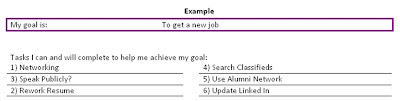 2. Set up a linear progression
With your list of possible tasks in front of you, go ahead and add numbers to them in the order that you would like to tackle them. (You'll notice this was already done in the example.) Be sure that they build on one another. For example, if one of your tasks is to run a mile, and another is to run in a 5k race, you’ll want to accomplish running a mile before running a 5k.
3. Break down tasks into actions
Then, once your list is in order, start by breaking down the first task into several actions. This process should repeat and repeat until you feel like you have a variety of actions that are of a manageable size.
To demonstrate this, the example (above) is continued below. This person's goal is to get a new job. The possible tasks are listed underneath the goal, and "Network" was designated task number 1, "Rework Resume" task number 2, and "Speak Publicly?" task number 3.
You'll notice that some of the tasks are broad, brush-stroke kind of tasks, like "LinkedIn" or "Alumni Network," and some of them are more specific, like "Networking Clubs – Ask Kirk, look online, ask John." If you trust yourself to follow through on a bigger, slightly vaguer action, then you can leave that action unexpanded. But if you have any doubt about your willingness or ability to get something like that done, expand it.
So what do you do if you have an action you want to perform but don’t know how to do it? Break that task down into “Ask for Help” and then expand that into a list of people you can contact for help!
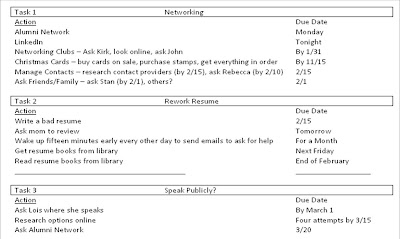 You'll notice on the example, too, that dates have been added. In adding these due dates, you'll want to keep Being Realistic in mind. Can you really write 500 pages by the end of the month? Can you commit to attending 5 networking events a week? Be gentle enough with yourself to avoid burnout, but challenging enough so that the effort of reaching your goal changes your day-to-day energy.
Each task and action should have a deadline for it. That said, the deadline can be “by next Friday,” “by March 1st,” or “by the end of the year.” As those deadlines approach, you’ll revisit the list of tasks and subtasks and update the deadlines.
You may notice that as you’re adding tasks and due dates that lots of emotions come up for you. Resistance, anger, fear, frustration, or just general discomfort. That’s because you’re making change. Achieving this goal is something you’ve wanted for some time, or you wouldn’t be going after it now. Just know that your challenge to the status quo is going to bring up some of these feelings.
And that’s totally ok! In fact, it’s good! A friend of mine used to say “if it’s uncomfortable, that’s good, it’s growth.”
These feelings are part of what we’ll be working on in the next post, so be sure to come back!
1. Brainstorm What’s Possible
Now that we know where we’re aiming, let’s map out how we’re going to get there. On a piece of paper, draw a box, and insert the Simple, Measurable, Active, Realistic, Timely, and Thrilling goal you generated in the last post. Underneath that box, write out a list of things that would be POSSIBLE to do to achieve that goal. As you write these things, remember that you're not creating a To Do list, you're simply generating a bunch of ideas.
As you brainstorm tasks on the path to your goal, keep the following questions in mind:
- What can I change in my life?
- What can I do more/less of?
- What skills or tools can I acquire?
- When will I spend time on this?
- What other area in my life can I use to help me?
- Who can I ask for help?
- Where can I learn more about how to achieve my goal?
2. Set up a linear progressionWith your list of possible tasks in front of you, go ahead and add numbers to them in the order that you would like to tackle them. (You'll notice this was already done in the example.) Be sure that they build on one another. For example, if one of your tasks is to run a mile, and another is to run in a 5k race, you’ll want to accomplish running a mile before running a 5k.
3. Break down tasks into actions
Then, once your list is in order, start by breaking down the first task into several actions. This process should repeat and repeat until you feel like you have a variety of actions that are of a manageable size.
To demonstrate this, the example (above) is continued below. This person's goal is to get a new job. The possible tasks are listed underneath the goal, and "Network" was designated task number 1, "Rework Resume" task number 2, and "Speak Publicly?" task number 3.
You'll notice that some of the tasks are broad, brush-stroke kind of tasks, like "LinkedIn" or "Alumni Network," and some of them are more specific, like "Networking Clubs – Ask Kirk, look online, ask John." If you trust yourself to follow through on a bigger, slightly vaguer action, then you can leave that action unexpanded. But if you have any doubt about your willingness or ability to get something like that done, expand it.
So what do you do if you have an action you want to perform but don’t know how to do it? Break that task down into “Ask for Help” and then expand that into a list of people you can contact for help!
You'll notice on the example, too, that dates have been added. In adding these due dates, you'll want to keep Being Realistic in mind. Can you really write 500 pages by the end of the month? Can you commit to attending 5 networking events a week? Be gentle enough with yourself to avoid burnout, but challenging enough so that the effort of reaching your goal changes your day-to-day energy.Each task and action should have a deadline for it. That said, the deadline can be “by next Friday,” “by March 1st,” or “by the end of the year.” As those deadlines approach, you’ll revisit the list of tasks and subtasks and update the deadlines.
You may notice that as you’re adding tasks and due dates that lots of emotions come up for you. Resistance, anger, fear, frustration, or just general discomfort. That’s because you’re making change. Achieving this goal is something you’ve wanted for some time, or you wouldn’t be going after it now. Just know that your challenge to the status quo is going to bring up some of these feelings.
And that’s totally ok! In fact, it’s good! A friend of mine used to say “if it’s uncomfortable, that’s good, it’s growth.”
These feelings are part of what we’ll be working on in the next post, so be sure to come back!
Friday, January 15, 2010
Resolutions to Results V: Get SMARTY!
So now that you've brainstormed some great ideas, you've prioritized those ideas, identified success, and visualized yourself achieving those goals, it’s time to get writing!
Writing out your goals makes it much more likely to achieve them. How much more likely? 900% (No, I'm kidding I made that up. I actually have no idea.) But from my personal experience, I can say that writing your goals down make them more real, more concrete, and therefore, more achievable.
(This doesn’t mean you can just write them and walk away, however!)
You've probably seen the goal-setting acronym "SMART" before. Lots of different people use these letters to mean lots of different things, and I think that, in general, any way you combine them they're right. The jist of all of them are the same.
However, I take SMART one step further, and encourage you to set goals for a SMARTY(pants), because it incorporates an element of goal setting that is missing from a lot of other approaches; the YES! factor.
Read on, dear reader, read on.
S: Keep it simple.
Your brain wants to remember as little as possible. Focus on the heart of what you want, and write it in the positive (not the negative -- like I'm doing here).
For example, if you want to stop biting your nails, phrase your goal as “I want to protect my nails from harm” or “I want to take care of my nails.” The reason I recommend this is that if you phrase a goal with a negative in it (quit smoking, stop overeating, stop dating losers), your brain remembers the positive – the smoking, the overeating, the dating losers. So give your brain a healthy, positive, SIMPLE thing on which to focus.
M: Make it Measurable
As we discussed in previous posts, if you can’t measure your success, you won’t know when you’ve achieved it. Avoid words like “more” and “better,” and instead focus on how much more? How much better?
A popular goal is to “get in shape.” What does that even mean? Walking a mile or running a marathon? Be specific! Giving yourself benchmarks to measure your progress will not only help you stay motivated, but it will make your goal setting more scientific and less ambiguous.
And ambiguous goals = kinda, sorta, maybe reachable ones.
A: Use Action Verbs
As good writers, actors, teachers, and others know, employing action verbs is critical. The same is true for writing goals. Using action verbs helps you create a goal that has movement behind it. So instead of setting a goal that is to “be more patient,” you can set one to “practice more patience.” It’s a subtle difference, but in those challenging moments, when you’re having a hard time sticking to your goals, having an action that you can perform (like “practice” instead of “be”) will help keep you on your path.
It may also open up other possibilities you haven’t considered. For example, if your goal is to “be in more shows,” if you rewrite it to “perform seven times this year,” that opens up the definition of “perform” and can help you see your goal in a new light.
If you have trouble coming up with action verbs, look here, here, or just google "action verbs."
R: Be Realistic (but challenging!)
"Realisitic" is not a synonym for "easy." Realistic, in this case, means actually doable, or attainable. You have the skills needed to do the work – or can develop them in the process. A realistic goal may push your abilities and knowledge, but it shouldn't break them.
A goal of never again eating sweets may not be realistic for someone who really enjoys candy. However, setting a goal of eating a piece of fruit each day instead of one chocolate is more realistic. You can then choose to work towards reducing the amount of candy gradually as and when this feels realistic for you.
Be sure to set goals that you can attain with some effort! Too difficult and you set the stage for the dreaded "failure," but too low sends your spirit the message that you aren't very capable. Set the bar high enough for a satisfying achievement!
T: Be Time-Bound
As we discussed while we were identifying success, set a timeframe for the goal: for next week, in three months, by your fortieth birthday. Putting an end point on your goal gives you a clear target to work towards, and helps you to break down the goal into chunks you can tackle one week, one month, and one year at a time.
If you don't set a deadline, the commitment is too vague and there's hardly any reason to start taking action now.
Also, be sure to give yourself enough time to reach the goal, but not so much time that you lose interest or motivation.
Y: Yes!! Thrill Yourself!
This is an element that is often left out of goal setting, and which is why you come to me! Be sure to pick a goal that excites, moves, and thrills you! I’ve said it before and I’ll say it again – if what you are trying to achieve is meant to please someone other than yourself, that goal is destined for failure. Find with WIIFM in the goal! And phrase it in such a way that it resonates with you and serves your values.
For example, “Lose weight” can become “lose 50 pounds by December so you can wear your skinny jeans next Christmas.”
Once you've come up with some goal statements, be brave -- add them to my comments! It will be one way to announce your commitment, and to share what you've learned with other readers!
Writing out your goals makes it much more likely to achieve them. How much more likely? 900% (No, I'm kidding I made that up. I actually have no idea.) But from my personal experience, I can say that writing your goals down make them more real, more concrete, and therefore, more achievable.
(This doesn’t mean you can just write them and walk away, however!)
You've probably seen the goal-setting acronym "SMART" before. Lots of different people use these letters to mean lots of different things, and I think that, in general, any way you combine them they're right. The jist of all of them are the same.
However, I take SMART one step further, and encourage you to set goals for a SMARTY(pants), because it incorporates an element of goal setting that is missing from a lot of other approaches; the YES! factor.
Read on, dear reader, read on.
S: Keep it simple.
Your brain wants to remember as little as possible. Focus on the heart of what you want, and write it in the positive (not the negative -- like I'm doing here).
For example, if you want to stop biting your nails, phrase your goal as “I want to protect my nails from harm” or “I want to take care of my nails.” The reason I recommend this is that if you phrase a goal with a negative in it (quit smoking, stop overeating, stop dating losers), your brain remembers the positive – the smoking, the overeating, the dating losers. So give your brain a healthy, positive, SIMPLE thing on which to focus.
M: Make it Measurable
As we discussed in previous posts, if you can’t measure your success, you won’t know when you’ve achieved it. Avoid words like “more” and “better,” and instead focus on how much more? How much better?
A popular goal is to “get in shape.” What does that even mean? Walking a mile or running a marathon? Be specific! Giving yourself benchmarks to measure your progress will not only help you stay motivated, but it will make your goal setting more scientific and less ambiguous.
And ambiguous goals = kinda, sorta, maybe reachable ones.
A: Use Action Verbs
As good writers, actors, teachers, and others know, employing action verbs is critical. The same is true for writing goals. Using action verbs helps you create a goal that has movement behind it. So instead of setting a goal that is to “be more patient,” you can set one to “practice more patience.” It’s a subtle difference, but in those challenging moments, when you’re having a hard time sticking to your goals, having an action that you can perform (like “practice” instead of “be”) will help keep you on your path.
It may also open up other possibilities you haven’t considered. For example, if your goal is to “be in more shows,” if you rewrite it to “perform seven times this year,” that opens up the definition of “perform” and can help you see your goal in a new light.
If you have trouble coming up with action verbs, look here, here, or just google "action verbs."
R: Be Realistic (but challenging!)
"Realisitic" is not a synonym for "easy." Realistic, in this case, means actually doable, or attainable. You have the skills needed to do the work – or can develop them in the process. A realistic goal may push your abilities and knowledge, but it shouldn't break them.
A goal of never again eating sweets may not be realistic for someone who really enjoys candy. However, setting a goal of eating a piece of fruit each day instead of one chocolate is more realistic. You can then choose to work towards reducing the amount of candy gradually as and when this feels realistic for you.
Be sure to set goals that you can attain with some effort! Too difficult and you set the stage for the dreaded "failure," but too low sends your spirit the message that you aren't very capable. Set the bar high enough for a satisfying achievement!
T: Be Time-Bound
As we discussed while we were identifying success, set a timeframe for the goal: for next week, in three months, by your fortieth birthday. Putting an end point on your goal gives you a clear target to work towards, and helps you to break down the goal into chunks you can tackle one week, one month, and one year at a time.
If you don't set a deadline, the commitment is too vague and there's hardly any reason to start taking action now.
Also, be sure to give yourself enough time to reach the goal, but not so much time that you lose interest or motivation.
Y: Yes!! Thrill Yourself!
This is an element that is often left out of goal setting, and which is why you come to me! Be sure to pick a goal that excites, moves, and thrills you! I’ve said it before and I’ll say it again – if what you are trying to achieve is meant to please someone other than yourself, that goal is destined for failure. Find with WIIFM in the goal! And phrase it in such a way that it resonates with you and serves your values.
For example, “Lose weight” can become “lose 50 pounds by December so you can wear your skinny jeans next Christmas.”
Once you've come up with some goal statements, be brave -- add them to my comments! It will be one way to announce your commitment, and to share what you've learned with other readers!
Saturday, January 9, 2010
Resolutions to Results III: Identifying Success (part two)
In the previous post, we discussed two tools to help you identify success and point yourself towards it -- Measurability and WIIFM (What's In It For Me?) In this post, we'll take a look at two other tools that will help you see what the successful achievement of your goal looks like.
3. Values Served
It’s crucial that your goals be in alignment with your values – the ideas and principles you hold near and dear to your heart. If your goals are not in alignment with your values, it will be harder to achieve them -- because achieving them may make you feel good, but it won’t thrill you in the same way as achieving something you value.
There are a number of ways to identify your values – and each could be a post of its own. I’ll cover these pretty quickly, but values are great things to on your own.
One way to identify your values is to simply think of the ideas and principles that are important to you. What do you value in your life? For me, things like "being real," "taking care of myself," and "growth" are hugely important. Make a list of the things that make up your backbone and keep you walking through life with pride. And if a value seems obvious to you, that's ok -- sometimes the obvious things are what keep us ticking.
Another way to identify your values is to think of the times in your life when you were most fulfilled – and then to look at what was underlying that fulfillment. For example, I remember being extremely happy with my mother recently. She was visiting, and I was doing a puppet show for her. The interaction touched on three values that are extremely important to me – family, laughter, and silliness.
A third way to identify values is to think of something that really pisses you off – rude people on the subway, litterbugs, etc. – and look at what it is inside of you that feels violated when you encounter those things. If your answer is "it's just not right" or "it's rude," dig a little deeper and see what's not right, and what's rude, and why those things matter to you.
Knowing which values you’re honoring by achieving the goal will also help you to identify which values you’re stepping on by NOT achieving the goal. And choosing to live in alignment with your values can be hugely freeing!
4. Good Enough
This is a loaded phrase. To some people it means “just barely getting by.” For others, it’s the unattainable goal, the feeling that you, yourself, are good enough. What I’d like this phrase to mean in this context is much more technical – “how much effort do I need to expend to feel I’ve achieved this goal?” What, in terms of achieving your goal, counts?
Try not to think of this as just scraping by, or doing the bare minimum, but rather, setting the finish line for yourself to cross, after which point everything else is gravy. This is where numbers can come in handy. Is 10 pounds good enough, or do you really need to lose 15 to feel successful? Is eating one extra vegetable a day good enough, or do you want to add in 15 servings a week to feel you're eating healthier?
When you add Measurability to a goal, combine it with the benefits of WIIFM, figure out which values are being served (and which are being stepped on without achieving this goal), and identify the finish line for yourself, you're prepared for success -- because you know what it is!
In the next post, we'll look at Visualizing Success, another important aspect of reaching your goals!
And don't forget -- spread the word! Blog readers can sign up for the Make It Happen Now! workshop at the discounted union price. Just contact me and let me know you saw it here!
Wednesday, January 6, 2010
Resolutions to Results III: Identifying Success
This is part three in an ongoing series of posts about setting (and reaching!) your goals this year. Part I (Brainstorming Goals) is here, and Part II (Prioritizing) is here. This post picks up where those two leave off.
Identifying the successful achievement of your goal is really important. If you don't know where you're going, how will you know when you've gotten there? In the course of the next two posts, I'll share with you some tools to use to identify a successful achievement of your goal.
1. Measurability
To identify success, your mind actually needs some numbers. If your goal is “to work more” this year, what does “more” mean? Is one show or published article enough? Or do you have to do six shows this year, or four published articles for it to count as “more”?
Similarly, if you want to lose weight, how much do you want to lose? “Some?” Or fifteen pounds? When you’ve lost a pound, are you halfway there, or are you one tenth of the way? It’s hard to stay motivated when the desired end results are vague. It’s also really easy to let yourself off the hook when you use “mushy” words to identify success.
Coming up with numbers helps you distribute the work that you’ll have to do over the course of a year. If you want to teach six classes this year, that’s one every other month, on average.
If you’re not sure how you want to define success, try picking something. Make it realistic -- not losing 100 pounds by Valentine’s day, or getting your demo produced tomorrow. But if you’re not sure what’s realistic, ask your friends and family. Ask someone else who's done what you're hoping to achieve. Or just pick something. If you don’t get there this year, then adjust for next year. If you get there too quickly this year, you can always add to your goal.
2. WIIFM -- What's In It For Me?
WIIFM is all about the benefits you’ll get when you achieve this goal. This is really the driving motivation behind going after this goal in the first place. You can start to answer this question by asking yourself the following questions: “What will I get when I’ve reached this goal?” “How will I feel?” “What will be different once I’ve achieved this goal?” “How will this achievement change my life?”
Answering these questions specifically and richly will help you to stay on target. For big challenges, you can post the answers to the WIIFM questions in areas of high visibility (the fridge, your screensaver, over the toilet). Remembering what you’ll gain from the achievement will help you in the moment-to-moment choice-making.
Join me in the next post for two more tools to help you identify success and point yourself more specifically in that direction.
And don't forget! There's still time to sign up for the Make It Happen Now! workshop that I'm offering on January 16th from 2-5 pm. Information and the sign up button can be found here.
Sunday, June 21, 2009
book review: Taming Your Gremlin
"You're too fat."
"You're stupid."
"You're a failure."
"You'll never get a job."
"You'll always be single."
"You're such a waste."
Any of that sound familiar? If so, you're human. (If not, congratulations!!)
I don't know about you, but the little voice inside my head can be so cruel sometimes that it's a miracle I can drag my ass out of bed in the morning and make it through a day. It judges me at every turn, telling me what "everybody" knows (that clearly, I don't) and gives me "helpful" pointers about how I should live my life.
Rick Carson, in his wonderful book, Taming Your Gremlin, calls this little voice the gremlin, and he offers useful tips for how to turn down its volume, and keep your head cleaner, clearer and more focused on who you really are.
The major tools he offers are these: Simply Noticing, Choosing and Playing with Options, and Being in Process.
Simply Noticing
It's as simple as it sounds. "Simply Noticing... is what happens when you experience the natural you and your surroundings without input from your gremlin." You can notice your body, the physical world, or the fact that you're paying attention to neither and are lost in the world inside your mind. This tool will help alert you to the presence (and "contributions") of your gremlin and can help you identify the voice that isn't yours. It also grounds you in the present, and reminds you that unless it's real (e.g. noticeable), it's probably fantasy.
Choosing and Playing with Options
Once you've simply noticed how irritating your gremlin can be, Carson offers five different options to play with to turn down the gremlin's volume. Since one of thes has been particularly useful to me in the last couple of weeks, I'll share more about it.
Breathe and Fully Experience. "If, instead of listening to your gremlin, you will simply breathe, feel your emotions, and give them lots of space in your body, you will notice that these emotions are no more than simple energy, and to experience energy is to feel vibrant and alive. ... The only time that emotions become dangerous is when we habitually bottle them up or discharge them impulsively without respect for other living things."
I met someone recently, (yes, a guy) and let me tell you, my life has been full of supercharged emotions and overwhelming gremlin chatter. (Let's just say that if my gremlin were communicating via cellphone, my bill would be in the thousands-of-dollars range.) Instead of freaking out, though, and taking foolish action to make my crazy feelings go away, I've been working to give them lots of space in my body and my life. More breathing, less doing/talking/thinking/judging/etc. It's been a major change, and one I can't recommend enough.
Carson shares additional tools, too, including changing just to show yourself and the world that you can do it, or speaking the words of your gremlin outloud, just to hear how absurd (or evil, or whatever) they are. All are useful (if you ask me).
Being in Process
"Being in process," says Carson, "is an attitude -- an appreciation of this simple truth and of the reality that your life will be forever unfolding and your future always unknown. ... Seeing yourself as in process will help you increase your level of simple moment-to-moment contentment and your appreciation of your very own gift of life."
This section of the book reminded me that there is no endgame, no finish line, no "being done" with change. That my gremlin will never fully disappear (even if I do manage to turn down the volume on him every now and then), but using the tools I have, I can create more happiness and peace for myself at every step along the way.
This book has been so helpful to me, I'm offering a two-night book group/workshop on it! July 7th and July 21st, I'll be gathering people in my office for a couple of hours to talk about what we learned, what we practiced, what resonated most with us, and how we can continue to use these tools to enrich our lives even more. If you're interested in joining, pick up a copy of the book, and drop me an email so I can share all the details!
"You're stupid."
"You're a failure."
"You'll never get a job."
"You'll always be single."
"You're such a waste."
Any of that sound familiar? If so, you're human. (If not, congratulations!!)
I don't know about you, but the little voice inside my head can be so cruel sometimes that it's a miracle I can drag my ass out of bed in the morning and make it through a day. It judges me at every turn, telling me what "everybody" knows (that clearly, I don't) and gives me "helpful" pointers about how I should live my life.
Rick Carson, in his wonderful book, Taming Your Gremlin, calls this little voice the gremlin, and he offers useful tips for how to turn down its volume, and keep your head cleaner, clearer and more focused on who you really are.
The major tools he offers are these: Simply Noticing, Choosing and Playing with Options, and Being in Process.
Simply Noticing
It's as simple as it sounds. "Simply Noticing... is what happens when you experience the natural you and your surroundings without input from your gremlin." You can notice your body, the physical world, or the fact that you're paying attention to neither and are lost in the world inside your mind. This tool will help alert you to the presence (and "contributions") of your gremlin and can help you identify the voice that isn't yours. It also grounds you in the present, and reminds you that unless it's real (e.g. noticeable), it's probably fantasy.
Choosing and Playing with Options
Once you've simply noticed how irritating your gremlin can be, Carson offers five different options to play with to turn down the gremlin's volume. Since one of thes has been particularly useful to me in the last couple of weeks, I'll share more about it.
Breathe and Fully Experience. "If, instead of listening to your gremlin, you will simply breathe, feel your emotions, and give them lots of space in your body, you will notice that these emotions are no more than simple energy, and to experience energy is to feel vibrant and alive. ... The only time that emotions become dangerous is when we habitually bottle them up or discharge them impulsively without respect for other living things."
I met someone recently, (yes, a guy) and let me tell you, my life has been full of supercharged emotions and overwhelming gremlin chatter. (Let's just say that if my gremlin were communicating via cellphone, my bill would be in the thousands-of-dollars range.) Instead of freaking out, though, and taking foolish action to make my crazy feelings go away, I've been working to give them lots of space in my body and my life. More breathing, less doing/talking/thinking/judging/etc. It's been a major change, and one I can't recommend enough.
Carson shares additional tools, too, including changing just to show yourself and the world that you can do it, or speaking the words of your gremlin outloud, just to hear how absurd (or evil, or whatever) they are. All are useful (if you ask me).
Being in Process
"Being in process," says Carson, "is an attitude -- an appreciation of this simple truth and of the reality that your life will be forever unfolding and your future always unknown. ... Seeing yourself as in process will help you increase your level of simple moment-to-moment contentment and your appreciation of your very own gift of life."
This section of the book reminded me that there is no endgame, no finish line, no "being done" with change. That my gremlin will never fully disappear (even if I do manage to turn down the volume on him every now and then), but using the tools I have, I can create more happiness and peace for myself at every step along the way.
This book has been so helpful to me, I'm offering a two-night book group/workshop on it! July 7th and July 21st, I'll be gathering people in my office for a couple of hours to talk about what we learned, what we practiced, what resonated most with us, and how we can continue to use these tools to enrich our lives even more. If you're interested in joining, pick up a copy of the book, and drop me an email so I can share all the details!
Wednesday, January 23, 2008
fearless living (a totally different three day conference)
With all the fearless living conferences I go to, you'd think I'd be fearlessly ruling the world by now. Alas, I'm not. I'm focusing on conquering a far more complex and confusing terrain -- me.
Over the long weekend, I went to a Fearless Foundation Workshop, run by Rhonda Britten (of Starting Over fame) and, while I won't go into the specifics of exactly what we covered (as that would breach my agreement with the Institute) I will give you a basic outline of what I learned, and why it's important to me -- for free!
(Aren't I just the best?)
First, Rhonda argues, when we experience negative emotions (anger, anxiety, frustration, despair, etc.) it's because we're being triggered by fear. We have one major fear, and when we can identify that fear, take a step back and stop reacting to it, we have much more freedom in our lives to make choices that actually serve us. Additionally, she argues, there is an essential nature that each of us has, but which we have denied, and only when we stop reacting from fear will we start to access that essential nature and end up with what she calls our "wholeness." My essential nature, as I discovered this weekend, is compassionate. And that may not surprise many of you, as I believe I'm an extremely compassionate person... to other people. Inside my own head, however, it's a bar brawl, with Judgment duking it out with Mean-Spiritedness (who is tag teamming with Not-Good-Enough). There's definitely an element of this that has served me over time (pushing me to go to Yale, driving me to be better and less complacent in just about everything I do), but more than not, it has been a really good tool for me to use to drive myself crazy. (Just ask my ex-boyfriends. I think they'll back me up on this.)
However, the problem a self-judger faces when she feels she is now tasked with the job of being compassionate is that it's really easy to sit there and tell yourself you're not being compassionate enough, or compassionate in the right way, or compassionate at all. (This was how I spent my Sunday night and Monday morning. Don't do this at home. It's exhausting.) The upside, it turns out, is that any decision I can make from a place outside of fear is already compassionate, by default! (Yippee!) The more I can do to take a step back, examine my behavior, take a deep breath, or stand up for myself (especially in the face of my greatest fear), the sweeter I will be to myself. The more I will move towards forgiving myself. The awesomer I will become.
So, while the conference was draining, at times irritating, and I basically felt like someone had taken the Jaws of Life, cracked open my rib cage and just kept spreading and spreading and spreading until there was next to no life left in me, it was totally worth it in the Peace of Mind department.
If you're interested in learning more about any of this, please let me know, visit www.fearlessliving.org, or read Rhonda's book, Fearless Living. I wouldn't recommend it for everyone, as it's really hard emotional work that will only benefit you if you're really ready for it, but if you feel stuck in a rut (either in your thoughts, career, behaviors, relationships, life, whatever) it'll totally help.
You may, in fact, never be the same again.
Over the long weekend, I went to a Fearless Foundation Workshop, run by Rhonda Britten (of Starting Over fame) and, while I won't go into the specifics of exactly what we covered (as that would breach my agreement with the Institute) I will give you a basic outline of what I learned, and why it's important to me -- for free!
(Aren't I just the best?)
First, Rhonda argues, when we experience negative emotions (anger, anxiety, frustration, despair, etc.) it's because we're being triggered by fear. We have one major fear, and when we can identify that fear, take a step back and stop reacting to it, we have much more freedom in our lives to make choices that actually serve us. Additionally, she argues, there is an essential nature that each of us has, but which we have denied, and only when we stop reacting from fear will we start to access that essential nature and end up with what she calls our "wholeness." My essential nature, as I discovered this weekend, is compassionate. And that may not surprise many of you, as I believe I'm an extremely compassionate person... to other people. Inside my own head, however, it's a bar brawl, with Judgment duking it out with Mean-Spiritedness (who is tag teamming with Not-Good-Enough). There's definitely an element of this that has served me over time (pushing me to go to Yale, driving me to be better and less complacent in just about everything I do), but more than not, it has been a really good tool for me to use to drive myself crazy. (Just ask my ex-boyfriends. I think they'll back me up on this.)
However, the problem a self-judger faces when she feels she is now tasked with the job of being compassionate is that it's really easy to sit there and tell yourself you're not being compassionate enough, or compassionate in the right way, or compassionate at all. (This was how I spent my Sunday night and Monday morning. Don't do this at home. It's exhausting.) The upside, it turns out, is that any decision I can make from a place outside of fear is already compassionate, by default! (Yippee!) The more I can do to take a step back, examine my behavior, take a deep breath, or stand up for myself (especially in the face of my greatest fear), the sweeter I will be to myself. The more I will move towards forgiving myself. The awesomer I will become.
So, while the conference was draining, at times irritating, and I basically felt like someone had taken the Jaws of Life, cracked open my rib cage and just kept spreading and spreading and spreading until there was next to no life left in me, it was totally worth it in the Peace of Mind department.
If you're interested in learning more about any of this, please let me know, visit www.fearlessliving.org, or read Rhonda's book, Fearless Living. I wouldn't recommend it for everyone, as it's really hard emotional work that will only benefit you if you're really ready for it, but if you feel stuck in a rut (either in your thoughts, career, behaviors, relationships, life, whatever) it'll totally help.
You may, in fact, never be the same again.
Monday, September 24, 2001
Get Out of the Way!
You got into this business for a reason, and things aren't quite panning out the way you thought they would. You're frustrated, angry, doing everything you know how to do, and you're not getting anywhere. Or maybe you think you're too old. Or too fat. Or too good to be without representation. You deserve better.
All you know is that you're sick of it, and something has to change! (Sound at all familiar?)
Well, I can help you change your mind.
On October 24th I'll be offering a class that will show you how your own mind is getting in the way of your success. We'll identify and eliminate your hidden beliefs about how the business works (or doesn't work), and you'll leave the class with a new, more powerful perspective on your art and career.
The details:
October 24th, 2-4pm
Ripley Grier Studios
Regular price $45 (Equity discount -- $40, Bring a friend -- 2 for $65)
Bring something to write with (and a journal, if you'd like)
Email k8sandberg@yahoo.com for more information
SEATS ARE LIMITED!
Wednesday, January 3, 2001
It's Time for a New Year's Evolution
Turn your 2012 Resolutions into Results!
Have you done the whole New Year’s Resolution thing before and not achieved the results you wanted? Instead of just promising yourself that you’ll do things differently this year, sign up for my next workshop to learn how best to set a goal, make a plan, and commit to change!
After just four hours together, you will:
· uncover ideas for goals you haven’t previously considered
· prioritize multiple goals
· define “success” and learn ways to measure your progress towards it
· identify potential obstacles and make a plan to subvert them
· utilize the multiple tools and handouts for setting future goals
· develop accountability partnerships to keep you on track
Sign up today!
Details:
January 21, 2012 from 12-4pm
at Shetler Studios, 244 West 54th Street, 12th Floor
Seats are limited!
Here's what you get:
Four hours of instruction (worth $120)
A workbook to use on your own at home (kind of like the home version of a game show!) (worth $35)
A one-on-one follow-up phone session with me (worth $75)
It's a $230 value, all for the incredibly low price of $60!
Here's what previous attendees have to say about the seminar:
"Trust me, you'll learn a lot in Kate's workshop and you'll leave inspired to learn more." -- Graham Coppin, Coach
"This class helped me align my goals and realize they are within my reach.” — Steve S., Tech Engineer
"I left this class filled with enthusiasm and the courage to go for what I want in my life." -- Jon A., musician


Subscribe to:
Posts (Atom)


 Posts
Posts


