Showing posts with label motivation. Show all posts

Saturday, December 29, 2012

Tools for the new year

Now is as good a time as any to start preparing for next year.  To help you do that, I've organized a number of tools that I think you may find useful in pursuing what you want next year.

1.  Me
Lest we forget that I am more than just a blogger, I will remind you that I coach, I teach, and I help get people unstuck from wherever they're stuck.  I charge $75 a session (which, in this world, is a STEAL) and I've got a lot of happy clients, with always room for one more...

2.  Make it Happen Now! Workshop, January 12th and 27th
This is a course I offer every year at the start of the year.  It helps you identify what you want, figure out what stands in your way, make a plan to go after what you want, and develop accountability to make sure you stick with your plan.  It's $75 for four hours and past participants have repeated the course year after year.  Find out more about it here.

3.  Notes from the Universe
This is a great site that will send you messages every weekday morning to remind you how wonderful you are and how you fit into the bigger picture of the universe around you.  I use them as a springboard for my meditation and to reconnect me with my heart.  Here's a sample message:
The one thing all famous authors, world-class athletes, business tycoons,singers, actors, and celebrated achievers in any field have in common, Kate,is that they all began their journeys when they were none of these things.Yet still, they began their journeys.You are so poised for greatness,The Universe
One day, they're going to name something big after you, Kate!Like a statue, a college... or a hurricane.
You can sign up for them at here.

4.  Robert Holden's Shift Happens
I've learned a lot from Robert Holden and find him to be one of the warmest, sweetest, and friendliest thinkers out there.  I've signed up for his mailing list and, like the Universe, every weekday morning I get a motivating message from him.  For example:

Today is a good day for forgiveness. Mind you, forgiveness is not for everyone. It is only for those who would like to experience peace, love, joy, bliss, healing, freedom, total salvation and things like that.

You can sign up here , where you'll find lots of other great tools from Robert, too.

5.  Coach Alba
This is a tool from the people at Change Anything that can help you stay on track by receiving texts to help you get through what they call "Crucial Moments."  I imagine I might use it at night when I have a tendency to eat mindlessly -- just a quick text from Coach Alba to remind me to be mindful, and all of a sudden I'm brought back to myself.  At the moment, it's programmed to best work with people who want to lose weight, though I imagine they'll come up with other iterations of it.

You can find it here.

6.  StickK
This is a site I wrote about earlier that provides you with external motivation when your internal motivation starts to lag.  Essentially what you do is sign up for a challenge -- losing weight, getting a new job, working on your memoir, writing a new song, whatever -- and then wager with stickK that you will commit to taking action on that goal, or you'll have to pay money, either to a friend, a charity, or an "anti-charity" (a cause you hate).  I've used this technique with clients before with really great results, but you can try it for yourself online here.

7.  Avoiding Destination Addiction
Just watch this video:
8.  My Previous Posts on Goal Setting

Wednesday, December 5, 2012

Dan Pink’s Drive


If you haven’t seen this video before, take 11 minutes and watch it now. Seriously. I’ll wait.


So I just finished a two day training on these concepts and, while it’s meant to address employees’ engagement and motivation, I think it holds true for our personal lives and the drive we have to live fully.

Think about it: what’s something that you do because you absolutely love doing it? Odds are there are three big contributors to what makes that fun and wonderful for you: Autonomy, Mastery, and Purpose.

Let’s take one of my favorite things to do – hiking. Part of the reason I love it is because I have autonomy over it – I can do it whenever I want (more or less) and there’s nobody breathing down my neck telling me how exactly to do it. Another part of the reason I love it is because I can get better at it. I can hike longer, higher, farther. I can get more present while I hike and get “in the zone” with it. And I see progress as I go along – the views at the top of a mountain, for example, make me feel like I have mastered something (even if it’s just my legs). And thirdly, hiking contributes to my sense of purpose – living more fully. It takes care of my body and mind (so I can help others take care of theirs). It connects me to myself and to whatever friends I hike with. It gets me out of self-doubt, and it’s fun.

Now think about something you don’t love to do. If you’re like me, it’s something like doing the dishes. You can use these same concepts to help yourself motivate through tasks you need to do but aren’t particularly jazzed about.

Dish-doing autonomy: I can decide when I want to do the dishes, what kind of soap to use, how hot the water is, and how long I let them pile up before doing them. This is way better than having a roommate pestering me about the stack of baked-on-caked-on-greasy-dirt-encrusted cookware.

Dish-doing mastery: In truth, I don’t care about getting better at doing dishes, but I do care that they’re done well. So I can focus my energy on making sure they’re socially acceptable. I can also use the time it takes to do dishes to get better at something else – maybe by listening to a podcast or news report, or by focusing my mind on the task at hand.

Dish-doing purpose: If I tie doing my dishes back to purpose, they become much easier to do. I do my dishes so I can take care of myself so I can help take care of others. Then dish-doing becomes a gift I give myself instead of a punishment I inflict on myself. I do my dishes so I can be a responsible adult. I do my dishes so my home reflects the way I feel about myself. Think about it like explaining why you do the dishes to a young person. This can help the young person in you connect more fully to the task at hand.

More neat insights to come, but I wanted to introduce you to Dan Pink and these concepts before, say, another month accidentally passes without me writing anything…

Friday, April 27, 2012

do nothing

Over a recent brunch of silver dollar pancakes and two eggs (scrambled), I was complaining to my dear friend Jimmy about how I feel like I'm not making progress in the things that I want in my life.  He put down his birthday french toast, smiled, and gave me some wise advice. He said:

“You need to spend more time up a tree, with your shoes off, eating jellybeans and watching the clouds go by.”

(Like this, but with jellybeans* ---->)

"You have no idea," he said (and I am here paraphrasing) "how hard you work.  You need to take more time OFF.  Don't push for an outcome, just let it come to you."

"But, but, but..." I stammered.  I'd never get ANYWHERE if I did THAT.  And there are things that I want.  I, I, I... I don't know what to DO.

"Do nothing."  he said. 

After brunch, it started to hit me.  I've gotten much more gentle with my expectations in the past five years but I still drive myself, and hard.  I rarely screw up, but when I do, the gloves come off.  I hold my tongue when others don’t do what I have asked them to do THREE TIMES, but if I spend a weekend without checking off everything on my to do list, it was a “waste” of a weekend.

This isn't working.

Especially because, upon reflection, I have evidence that my weekend wasn't a waste.  I mopped the floor, baked a cake, took my friend out for birthday brunch, downloaded Office 2010 onto my computer, and watched several hours of Planet Earth, the nutritional supplement of television.  I didn't do nothing!

What I'm getting at is that it's time for me, once again, to question what it is that drives me.  Where did I learn my standards for what is and isn't ok, and am I willing to revise them?  Are they serving me?  Or are they holding me back? 

What good is going for perfection if it only makes me feel broken along the way?

Thanks, Jimmy.  Happy birthday!


* I may have made up the part about eating jellybeans, but it really should be in there, so I’m pretending it was.

Monday, November 8, 2010

carrots and sticks and bears, oh my!

I've been reading an interesting book about motivation and sticking to your commitments called Carrots and Sticks, written by a Yale professor of economics. The book proposes two different approaches to goal-reaching; being rewarded for reaching milestones along your journey, and being punished for not doing so.

(Hence, carrots and sticks.)

The interesting thing, though, is that Ian Ayres (the author) has built a website, www.stickk.com, that allows people to put up a certain amount of their own money as a bet against their failure. For example, Ayers himself has been striving to keep his weight under 180 pounds. To aid in this, he has agreed that stickk.com can take the $500 he has put at risk every week if he goes over 180. Even more compellingly, he has agreed that stickk.com can send that money to a cause he does not support.

How does the website know that he's gone over 180 pounds? Well, he tells them. Part of Ayres' commitment is his willingness to participate in the contract (and report honestly) in the first place. Because are you really going to bet $500 that you'll stop a behavior you kindasortakinda want to stop? I doubt it. Stickk.com encourages users to identify an external arbiter to oversee these contracts -- someone like a coach, for example -- to make sure the person is reporting honestly, and really making use of the system.

Because once someone lies about one commitment, the whole thing is shot.

I find this particular type of motivation both exciting and terrifying. Putting $500 of my own money at risk would ensure that any undesired behavior would cease to happen -- especially if that money was going to, say, the NRA, the Tea Party, or Sarah Palin's campaign fund -- and yet, I don't know if I could forgive myself if an emergency happened and I couldn't stick to my commitment. Not only would I be letting myself down, I'd be out $500, and would probably have to drum up another $500 to donate to positive causes to balance out the harm I've done.

And that's what I like about using money as a motivator; it brings the issue into the front of my consciousness. There are a number of things I want to do -- like blogging regularly -- that, if I lost $500 every time I didn't do them would happen more often. At the same time, I'm not sure I'd want to live with the stress of that kind of money hanging over me.

A client of mine is using this approach -- not through the website, but through a verbal agreement with me -- and I'm amazed to see the amount of work he's doing. Will this last longer than one week? I'm not sure. But it definitely is motivating him to make absolutely sure the desired behavior happens seven days in a row.

Who knew Sarah Palin could be so useful?

Monday, August 23, 2010

rising to the challenge

(This is a copy of an article that a friend requested for the secretarial newsletter at her firm. If it sounds kinda formal and talks about work a lot, that's why.)

There is a huge opportunity to grow through a challenge – just ask first-year marathon runners. People who never thought they could run 0.2 miles (let alone 26.2) will tell you that by overcoming the challenge they set for themselves to simply finish the race, they feel more confident in their abilities to do a wide variety of other things. The same is true for athletes, artist, businesspeople, and anyone who puts him- or herself up to a challenge.

Facing a challenge will stretch you and help you find reserves inside of you that you didn’t know you had. And the challenge doesn’t have to be as epic as a marathon; it can simply be pushing yourself to stop eating candy in the late afternoon or to strike up a conversation with that good looking guy in your conversational French class.

Sometimes challenges come at us when we least expect them, and we can’t even see that they’re happening. We overlook opportunities to grow because we see them as “not my job” or “never going to happen.” Missing them is easy – but so is grabbing them before they pass. Catch yourself saying these three things, “I can’t,” “I should,” or “it’s hard,” and there’s a good chance you’re facing a challenge.

I can’t
There is very little in this world that can’t be done given infinite resources, so there isn’t anything, in fact, that you can’t do. I can’t climb Mt. Everest, you say. Well, that’s not actually true. If you gave up your normal life, moved to Tibet, paid a boatload of money, and trained for the next several years, you could climb Mt. Everest. So it’s not the case that you can’t climb Mt. Everest, it’s that you are choosing not to give up your normal life, move to Tibet, pay a boatload of money and train for the next several years. (And I can’t say I blame you for that decision.)

Or rather, let’s say an attorney gives you a document as you’re walking out the door to lunch with an old friend. “I need a million copies of this document before you go,” she says, looking panicked and frazzled. You call your friend. “I can’t go to lunch today, I have to make a million copies.” Now, is it actually true that you can’t go to lunch? Are you physically incapable of leaving? No, of course not. You are simply choosing to stay to make the million copies – maybe because this attorney brought you breakfast this morning, or because she’s new here and has been under a lot of pressure, too, or simply because it’s your job. Whatever the reason, the truth is that you are choosing to skip lunch, so why not explain your behavior in terms of what you’re choosing instead of what you’re giving up? Using “I can’t” in your vocabulary turns you into a victim. Try replacing it with “I choose not to” and see what changes.

(Already, saying “I choose not to climb Mt. Everest” sounds pretty good.)

I should
Just thinking about the things one should do is exhausting. There’s a dragging sense of obligation, leaving no room for fun around eating more vegetables, going to the gym, or cleaning your bathtub. But when you think of the things you want to do, the excitement comes back – feeling more fit and not being grossed out when you shower are more worth the effort it will take to make them happen.

When you’re being challenged, it’s easy to fall back into the habit of “shoulding.” This means thinking in terms of obligations and expectations, and not in terms of opportunities and fun. Let’s say your current challenge is getting to work on time. “I really should get up earlier,” you say to a supervisor. However, if that supervisor’s smart, he won’t expect to see you follow through with that until you start talking about what you want to do. “I want to get up earlier so I can read the paper and still get to work on time” is much more likely to yield results.

It’s hard
This is the biggest and easiest trap to fall into when you’re facing a challenge. Whatever it is – running a marathon or eating less candy – of course it’s hard! If it were easy, it wouldn’t be a challenge. However, using that particular phrase, “it’s hard,” drains the situation of any motivation. It’s the king of cop outs.

What if, instead, you faced a difficult situation by saying “it’s a challenge”? The change in wording instantly makes the situation seem more doable – all kinds of people rise to challenges every day. Facing a challenge with the intention of growing increases your motivation to actually accomplish the task.

Let’s look again at the million copies scenario. Sure, it would be hard to make a million copies before lunch, but if you see it as a challenge, you cast it in a different light. There are more options, more choices, and you’ll see more results.

Winston Churchill, the master at facing enormous challenges, once said, “A pessimist sees the difficulty in every opportunity; an optimist sees the opportunity in every difficulty.” Since you get to choose how you see a situation, would you rather be a pessimist or an optimist?

Thursday, August 5, 2010

what's your positivity ratio?

Yesterday I was on a webinar called "Boost Your Happiness Through Evidence-Based Activities," and, while it was kind of a cheesetastic hour, there was one exercise I came out of it with that I found interesting and worth sharing.

It's about your positivity ratio.

Think about the last 24 hours. And in the last 24 hours, have you felt any of the following:
Amazement
Amusement
Gratitude
Hope
Interest
Inspiration
Joy
Love
Pride
Serenity

You can have felt them a little, moderately, or a lot. (If you only felt them a little, don't count them in this round.)

Total up the number you've felt and put that number aside.

Now think about the last 24 hours again. Have you felt any of these?
Anger
Contempt
Disgust
Embarrassment
Fear
Guilt
Hate
Sadness
Shame
Stress

Again, you can have felt these a little, moderately, or a lot. (With these, if you felt them a little, they count.)

Take your positive total, and divide it by your negative total. That's your positivity ratio.

The inventor of this test, Dr. Barabara Fredrickson, has research indicating that "a positivity ratio of 3 to 1 is a tipping point. This ratio divides those who merely get by in life from those who truly flourish."

But if you scored below 3-to-1, don't be surprised. More than 80% of U.S. adults fall short of the ideal 3-to-1 ratio. (I did, too, and I consider myself a highly positive person.) Instead of feeling guilt, shame, or stress over these results (because, watch out, you'll have to account for those tomorrow!) why not take interest in what you can do to up your ratio? Why not seek out a poem, a song, or a friend who inspires or amazes you?

You are in charge of where you put your attention. So when you catch yourself in a feeling of anger, frustration, or guilt, take some time to balance that out with some love, amusement, or gratitude. A simple way to approach this is through an exercise where you list five things you're grateful for -- like the comfort of your fluffiest pillow, the crispy, minty taste of your toothpaste, or the support of the people who love you -- and really sit in that gratitude as you move through your day. Similarly, sit down and list things that crack you up -- like the way your sister snorts when she laughs really hard, the way a muppet ends a joke by settling down into its neck, or that cute guy who is ninja funny -- and just sit with the enjoyment of that for a while.

Negative stuff will come and go, and I personally have a harder time keeping the negative feelings at bay than I do redirecting my attention onto the stuff that makes me happy. So this is a good exercise for me, too.

(And in just writing this post I've upped my hope, amusement, inspiration and gratitude quotients for today, so maybe tomorrow I'll have a 3-to-1!)

Thursday, June 17, 2010

what motivates YOU?

Below is a really fascinating video on what motivates people inside an organization to perform better. It talks about how money alone is not enough, and points to the ideas of autonomy and purpose as driving factors behind organizational behavior.

So how does this apply to you?

Thursday, May 20, 2010

identifying and changing habits

A recent article published in the Wall Street Journal talks about a study done to see what effect having "social support" has on peoples' willingness to get exercise.

"The study, conducted by Stanford University, belongs to a growing body of research showing that small amounts of social support, ranging from friends who encourage each other by email to occasional meetings with a fitness counselor, can produce large and lasting gains against one of America's biggest health problems—physical inactivity. Only 48% of Americans say they meet the federal recommendation for exercising half an hour most days of the week, and the actual percentage is believed to be much lower. Exercise researchers estimate that nearly all sedentary people at one time or another have resolved and failed to maintain exercise programs."

The story goes on to talk about how having accountability for her behavior led one woman to start an exercise program that, over time, just became a habit. And the results of the study showed that everyone who participated -- whether they had regular reminders or not -- was working out more often. However, those who were receiving calls from a live person had the longest-term success, almost doubling the time they spent exercising. "When you knew you were going to have to report back on what you had done, it motivated you," said one participant.

And this motivation is part of what coaching is all about. Creating a relationship that deepens accountability and responsibility. Working together to support you in your desire to change a habit -- something that you may not even be able to identify as a "habit" at the moment, especially if it just feels like "just the way things are" (or, more trickily, "just the way I am").

So, short of dropping me an email and signing up for a free sample session, what can you do? Well, there's a website called Habit Forge that will let you sign up for daily accountability emails. You simply tell the site what you want to achieve, check your email every day, answer the question "were you successful at achieving your goal?" and, if you answer YES for 21 days in a row, you go into "Monitoring Mode." A pretty painless way to give it a shot, no?

And it's free, so why not check it out? (And hey! A sample session is also free...)

Sunday, May 16, 2010

a handful of inspirational quotes

"I am only one, but still I am one. I cannot do everything, but still I can do something. And because I cannot do everything I will not refuse to do the something that I can do." -- Helen Keller

"Be yourself. Everyone else is taken." -- Oscar Wilde

"Half of the troubles of this life can be traced to saying yes too quickly and not saying no soon enough." -- Josh Billings

"The thing always happens that you really believe in; and the belief in a thing makes it happen." -- Frank Loyd Wright

"Even if you're on the right track, you'll get run over if you just sit there" -- Will Rogers

"Until one is committed, there is hesitancy, the chance to draw back, always ineffectiveness, concerning all acts of initiative (and creation). There is one elementary truth the ignorance of which kills countless ideas and splendid plans: that the moment one definitely commits oneself, then Providence moves too. All sorts of things occur to help one that would never otherwise have occurred. A whole stream of events issues from the decision, raising in one's favor all manner of unforseen incidents and meetings and material assistance which no man could have dreamed would have come his way..." – Goethe

"It is not in doing what you like, but in liking what you do that is the secret of happiness." -- J.M. Barrie

"So many of our dreams at first seem impossible, then they seem improbable, and then, when we summon the will, they soon become inevitable." -- Christopher Reeve

And my favorites:
"The future has several names. For the weak, it is the impossible. For the fainthearted, it is the unknown. For the thoughtful and valiant, it is the ideal." -- Victor Hugo

("And for Michael J. Fox," said my office mate Fernando, "it's the thing you have to go back to.")

Saturday, May 1, 2010

Failure Is NOT An Option? (Well, Maybe It SHOULD Be!) by Rebecca Soulette

I'm sure you've heard the (supposedly) motivational words, Failure Is Not An Option , as a way to inspire people to do great things. It makes great ad copy when selling sneakers or gatorade, and it ALWAYS makes for stirring interviews when people like Donald Trump, Olympic gold medalists, and award winners from every walk of life say it.

The Failure Is Not An Option perspective is a state of mind that can be extremely useful in helping us to keep moving forward no matter what setbacks come our way. But it can also do the EXACT OPPOSITE.

For those of us who were born (or raised) as perfectionists, or for those of us who overwhelm easily, the Failure Is Not An Option mentality can actually paralyze us before we even begin.

Why?

Because if we're trying something new, by definition, we're ATTEMPTING something we've never done before. And if we've never done it before (or if we currently suck at something that we're trying to improve at it) we don't know how to do it well yet. And expecting ourselves to be perfect at something we don't actually know how to do well yet can be A LOT of pressure.

Just imagine if you're teaching a baby to walk. Little Junior has started hoisting himself up to a standing position on the coffee table and looks JUST ABOUT ready to let go and take a step or two toward you. Now, imagine if your words to him were, "Okay, Kiddo, Failure Is NOT An Option --let go of the table and walk over to me. Don't screw up! And, whatever you do, you CAN'T fall down!"

Luckily, most children who are about to take their first steps are too young to even understand what you'd be talking about if you were to say that to them, yet, isn't that what we're saying to ourselves when we imagine that Failure Is Not An Option; that we have to perform perfectly?

Everyone knows that MOST children, on letting go of the table and lunging forward, trying to take a step will end up falling on their butt on the floor--if not during the first step, then during the second or the third--and even if they successfully walk, they are bound to fall again the minute they start adding speed, turns, or enthusiasm to the mix. Not to mention that most babies don't even know what they did to make themselves walk the first time they do it, since they're so surprised it worked, they don't always know how to repeat what they just did.

The step that the idea Failure Is Not An Option MISSES is that there IS no success or improvement without failure. Yes, occasionally, we may be lucky and the first time out trying something new. We do well (and label it "beginner's luck" not "beginner's solid and completely dependable talent"), but MOST of the time we WILL screw up, fail, fall, or, at the very least, have a type-o. And what's GOOD about that (Yes, it's good! I swear!!!!) is that THAT is how we learn to do better. We can't course-correct if we don't go OFF course first. We can't refine anything until we do it just a little bit wrong. And we can't learn what to do unless we become absolutely sure about what we DON'T want to do. It's all part of the same process that leads us to success. And to put the kind of pressure on ourselves that we're NOT ALLOWED to screw up is counter productive. How can we learn if we can't screw up?

If I had fallen as a baby learning to walk (which, believe me, I did!) does that mean I should have quit and never tried doing it again because I didn't do it perfectly the first time? Absolutely not. With that logic, I'd still be crying, flat on my diapered butt by the coffee table in our old apartment, never having learned to walk.

So maybe it's time I (and all of us) try on the idea that not only IS failure an option, it may even be a REQUIREMENT on the road to progress and success.

This week, if you're like me and get paralyzed by the idea thatFailure Is Not An Option I invite you to turn that idea on it's ear and see how much easier it may be for you to take strides forward if you let yourself see failure for the learning and improvement tool that it actually is!

About Rebecca Soulette, CFLC III ~~~~~~~~~~~~~~~~~~~~~~~~~~~~~~~~~~~~~~~~~~ Life Coach, Rebecca Soulette, CFLC III, is a senior level coach certified through the Fearless Living Institute. She is an expert in helping her clients to live the lives they were born to live. She is also the creator of http://www.lifebeyondcelebrity.com/ , where she helps celebrities and others in the public eye create balanced and fulfilling lives beyond their fame. Rebecca Soulette, CFLC III, also offers teleclasses, private 1:1 and group coaching. To help both celebrites and non-celebrities alike live the lives the were born to live. Learn more now at http://www.rebeccasoulette.com/ .

Sunday, April 25, 2010

there is no such thing as delay

I went to hear Michael Beckwith speak recently, and if you're not familiar with who he is, he's a non-denominational reverend who is more into god than any particular manifestation of him.

(He's also a better looking version of Milli or Vanilli, take your pick.)

His topic was something like "Finding Your Soul's Purpose," and I went to listen because I'm feeling a little stuck these days. I was excited to hear what someone with a different (and famously motivating) perspective would have to say on the topic, except... well, he never really got around to talking about the topic.

Instead we were greeted with a number of things I didn't particularly care for in his presentation, including a ten minute segment from his "dance minister" who wore a gauzy dress and flailed herself around in front of a room of paying customers, and a twenty minute version of a song whose title I can only assume was "I'm So Grateful that I Just Can't Stop Singing -- in English or in Spanish -- I'll just Keep on Going Forever," but that's neither here nor there.

Despite my mounting frustration, I stayed and listened for whatever nugget I could take away, and what I got was this:

There is No Delay in the Universe.

Beckwith's argument was that the Universe is perfect. It's perfectly balanced energy, and we (each of us) occupy a perfectly balanced place in it. I am a Kate-shaped energy inside of a Kate-shaped hole in the universal energy. (Or something like that.) So if something in your life feels stalled or delayed, that's only your perspective on it. The Universe (he argued) knows nothing about delay. All it knows is that you don't yet have the skills or tools or support or energy or whatever you need to move on to the next level.

Now, while this is a little bit of a Super Mario Brothers interpretation of the Universe, I like it. I like the idea that the reason I feel stuck is that there's something I haven't learned or gotten or processed yet, and this lull, this slow-down, is an opportunity for me to catch up on whatever that is.

So if you're in a place where you feel stalled, trapped, stuck, or otherwise Not Moving, ask around and see if there's something you don't have or know yet that would help you move into your next chapter. You might just be surprised.

(Although if the Universe tells you to become a dance minister, I might not listen...)

Thursday, March 4, 2010

don't give up!

I know I've written a lot lately about goals, and reaching for what you want, and all that good stuff, so I thought I'd share with you part of an article on motivation that I got from another savvy coach, Nancy Fox. (Visit her at www.thebusinessfox.com) The whole article is more in-depth, but the part that resonated most with me broke down the stages of decision-making:
  1. "Action/Decision - you take some new action or make a decision
  2. Relief/Excitement - this provides relief or excitement - You look forward to the new.
  3. Doubt - the relief or excitement is short-lived. Doubt for your decision or about your action sets in.
  4. Fear/Overwhelm - Doubt is immediately followed by fear or a feeling of being overwhelmed.
  5. Remorse/Regret - You begin to regret your choice or action. (This is what is commonly known as "buyers remorse.")
  6. Projecting Blame - You immediately start seeking who you might blame for the feeling of remorse. You see it as a force outside of yourself. Ex. Your partner was a bad guy anyway, your boss never told you what he/she really expected, etc.
  7. Seeking Shelter/Safety - Here's where you want to pull back or go back to old familiar ways. Ex. You want to stay in your current job vs. making a change to one with greater potential.
  8. Relief - You feel a short-lived sense of relief.
  9. Lowered self-esteem - Right below relief is an experience of lowered self-esteem because you have not made a decision from a powerful stance but from a fearful one."
I love the way this breaks down because I can see myself in every one of those steps. (I've gotten a lot better about #6, though!) I've definitely made decisions, gotten excited, doubted, gotten scared, and started to change my mind. For me, the "seeking shelter/safety" is extra powerful, because it leads to that blessed, almost instantaneous relief of not having to do anything.

However...

When the change is important to me, I build in safeguards to ward off steps 5, 6, and 7, and therefore avoid steps 8 and 9 all together.

Nancy's suggestions for safeguards are the following:
  1. "Accepting Full Responsibility - for your situation and for your results. No excuses. Gives you a huge sense of power.
  2. Adopting A Can Do Mindset - Listen to your language. Are you telling yourself it can be done, or it can't? Either way you'll be right. Your choice.
  3. Trusting - In yourself and your ability to generate the right results.
  4. Seeking Support - Hang around with supportive people, hang with the winners.
  5. Positive People, Positive Life - self explanatory.
  6. Daily Consistent Actions - Put the right structures, right routines in place and adhere to them as if they are the law - your law.
  7. Focus on your WHY - By focusing on your real purpose, why you took the action, you will be motivated to stick to it."

I think these suggestions are spot on, and will affect different people in different ways. For example, #4 is crucial for me -- I'm a talker. And I can talk myself out of fear just as easily as I can talk myself into it. So combining supportive people with consistent, daily actions, often helps me overcome my fear in a plow-ahead-like-a-freight-train kind of way. Sure, it's scary, but if I do #7 and ramp up #3 (possibly via #2 and #1), I can make it through.

Monday, March 1, 2010

put on your big girl panties

I worked way more than I am used to this week (six days in a row, and one of them was from 9 to 9) so when Sunday rolled around and I finally had a day off, I didn't want to do ANYTHING. Just sit on the couch, nurse my burgeoning cold, and decompress.

Except... if I did that, I'd have nothing to wear, nothing to eat, a gym membership going to waste, and nothing but regrets on Monday.

So what did I do? I put on my big girl panties and did what needed to be done. I washed my clothes, went to the gym, bought groceries, cooked like a banshee* and even ironed my blouses. AND somewhere in there, I found time to see a movie and go shopping with my friend.

Now, I'm not looking for praise or claiming to be a superhero because I managed to do my chores. What I am looking for, though, is the mechanism by which I was able to drag my tired ass off the couch and over to the ironing board. That feeling of responsibility, or accountability, or need-to-do-this-ness that I am calling, for lack of a better name, my big girl panties.

Big girl panties have shown up in a lot of places in my life. In college, I put on my BGP's to crank out a paper while everyone else was drinking beers in the courtyard. As an actor, I wore my BGP's during tech week when things just needed to be done, and I was the one to do them, 3am or not. Now I wear them when a date I like doesn't call me back, or when the dishes are stacked higher than I am tall, or when I just donwanna do whatever it is that's facing me. Because wearing my BGP's is one way that I can take care of me.

I have, in the past, been susceptible to feelings of victimhood -- "oh woe is me, I worked so hard this week, won't someone swoop in here and do my laundry?" But at some point I realized that it's all about choice. I could, in fact, pay someone to swoop in and do my laundry, but that'd cost me $30. I could choose to sit on the couch, zone out like a 'tater and not take care of myself, and then, when I want to eat, I'll have to choose between eating saltines and raisins or spending $20 on dinner. I could get my shirts ironed... for $1.50 apiece, two blocks away. (You get my point.)

Instead, I stepped up, threw on my big girl panties, and took care of myself. I gave myself the gift of doing things the way I like them, when I want them done, for free.

And, truth be told, when my blouses were all ironed and hung in the closet, my clothes were folded and put away, my food cooked (healthily), and my legs aching from the weight room, I felt good. I felt financially responsible, well-cared-for, and independent -- all qualities I value having in my life.

So look at your life. Where do you struggle with wanting or not wanting to do something? What are the payoffs for sitting on the couch (metaphorically or actually)? And what are the payoffs for getting up? Will what you're avoiding actually go away if you ignore it today? And will what you're doing instead actually make you feel better? If the answers to those are "yes," then this may not be the day for your big girl panties.

But I'd pack them anyway. Just in case.

*I'm not 100% sure banshees eat, let alone cook.

Saturday, January 30, 2010

Resolutions to Results IX: Commit!

The last step in this amazing process is committing to achieving this goal with your whole heart and soul.

What does that mean? It means making your goal a priority in your life. Spending a little time every day (or a lot of time on a few days) working -- possibly struggling -- towards this goal. It means keeping at it after others have quit. Sticking to it in bad moods and good moods.

As you prepare to commit, ask yourself the following questions:
1. Am I willing to pay the price it will cost to get this goal?
2. Am I willing to stick with this until I get it?
3. Is this goal humanly possible?

As you review the work you've done, look at the things you stand to gain and lose from this achievement and decide whether or not this is something you are committed to doing, willy nilly, from this second in time forward. Once you commit to pursuing this goal, there will be no going back to the way things were before. You can always re-evaluate and reprioritize your goals, but going back to things the way they were before this work is just not an option.

When you're ready to commit to this goal, take a deep breath, and declare outloud, "I am committed to [insert your goal here]."

And you're off and running!

Wednesday, January 27, 2010

From Resolutions to Results VIII: Get Support

Now that you've got a Simple, Measurable, Active, Realistic, Timely, and Thrilling goal with due dates assigned, you've got to get going! However, trying to do it alone can be incredibly difficult.

Finding mentors and accountability partners will increase your success rate dramatically. But who do you ask? Your mom? Your husband? Maybe, maybe not. Look at your list of roles and responsibilities from the first post: which relationships on that list would benefit most from you achieving your goal? Who in your life is already achieving your goal at the level at which you’d like to achieve it?

I really recommend accountability partnerships for achieving goals. While it’s tempting to ask those closest to you to be your accountability partners, that could be a trap. Whether we like it or not, there are rules in the relationships we’ve already established. If you’re the fat sister, using your (skinny) sister as your accountability partner for losing weight might backfire.

Instead, setting up a clearly negotiated partnership with someone you don't know quite as well could serve your goal better. With those people, you can explicitly design your relationship and your interactions. You can agree “I will email you about my successes three times a week and no more.” A friend might be confused by this, or feel used, but an accountability partner will reap the same benefits by sharing with you in a similar fashion. Take a few minutes to identify people in your life who can serve you as accountability partners, and then start asking around!

Announcing your goal to others is important, too, and has lots of benefits – it forces you to verbally clarify what it is you want, and allows your ears to hear your mouth committing to a goal. It puts your quest more on display, and can give you more positive feedback from the people around you who hear about it.

So where do you announce your goal? Anywhere! Your facebook status is a great place to start... as are the comments of this blog! (Just sayin'.)

Sunday, January 24, 2010

Resolutions to Results VII: Identifying Obstacles

Identify Your Obstacles

So now that you are armed with this fabulously detailed and due-dated plan, what’s going to cock it all up? What’s going to get in your way and keep you from achieving this goal? (If your answer is “nothing,” you’re not trying hard enough.)

So, really: what stands between you and achieving your goal? Questions to ask yourself to uncover your obstacles are these:

  • Why haven’t you achieved this in the past?

What other goals have you attempted and quit? Do you want to approach this one the same way? If not, what will it take from you to do things differently this time?

  • What are you afraid of?

There are lots of things to be afraid of, but change isn't necessarily one of them. Are you worried that you'll have to work more, sleep less, sweat more? Are you afraid you'll have to give up your security blanket -- whatever that means to you? Be honest with yourself about what scares you so you are better equipped to face that fear instead of waiting to be sideswiped by it. And nobody's judging you on what scares you. This is between you and you, so be real.

  • What will change in your life if you succeed at this goal?

This question addresses both the WIIFM (which we talked about earlier) and the OGTSC (the Oh God, That's Scary Crap*) that is likely to come up as you make change. Really look into your future and see the stuff you WANT to change -- what else is likely to change as a side-effect?

  • What can I do to prepare myself for this?

Only you really know the answer for this. I know that I am challenged by feeling lonely late at night, and one of the things I do to compensate is to eat. So if my goal is to lose weight, I know I'm going to have to make a plan to handle the feelings of loneliness so that I don't throw myself off target by eating late at night. To address this, I could challenge myself to read 50 pages every night (which would be hard to do while foraging for snacks in the kitchen) or make a plan to call a different friend each weeknight to catch up. Your preparation will be different, but you'll know what to do!

  • Who doesn’t want you to change?

What are some of the “silent agreements” you have with people – those unspoken social contracts we make and get stuck to like library paste (the not-tasty kind). Are you the obedient daughter? The athletic son? The quiet roommate? The responsible husband? If you think you have no silent contracts, go back and look at your Roles and Responsibilities exercise. Which job do you have that interacts with another person? And would that person be happy if you were to change some of the responsibilities you had in that job? (I'm just sayin'...)

Tips for Handling Obstacles!
"Every successful man I have heard of has done the best he could with conditions as he found them, and not waited until the next year for better." – Edgar Watson Howe, publisher

Keep Anticipating Obstacles. Today you’re predicting what you think will get in the way, but as you make new progress, unforeseen obstacles can crop up. As you see them, write them down. Often just being aware of what’s in your way can help you to find creative ways around it. Look at both external and internal obstacles. Who are the people in your way? What are the circumstances blocking you? Do you have the tools you need to get the job done? What are the limiting beliefs you have that keep you from achieving your goal? Writing down obstacles takes them out of your head and puts them on paper, where it’s easier to be more objective about them.

What are the payoffs? What do you get by not reaching your goal? If you succeed, will you have to give up the fuzzy coziness your comfort zone? Will you have to work harder than you do now? Will you have to give up the image you have of yourself as a victim, and, as a result, give up the attention and sympathy that others give you? It’s human nature to want to stay “safe,” especially if it’s comfortable and secure. Forgive yourself for having been willing to hold onto the obstacles, and then let them go. Embrace change and be courageous!

Identify the moment it goes awry. If you have been diligently working towards your goal and then “slip,” identify the moment your thoughts turned from striving to settling. What specific thoughts did you think that allowed you to eat the sweets, spend the money, skip the audition? Have patience and gentleness with yourself on this one – this process takes time and energy, and often requires making more mistakes than you’d prefer. The benefit is that every “mistake” is a learning opportunity. There is no failure – only a chance to learn more and grow more.

Use traditionally “creative” techniques to open up your mind. Drawing, painting, sculpting, singing, writing… they can all contribute to deepening the vision you have of your goal. You can also use them to overcome obstacles – draw the things that are in your way, the things that you are afraid of, the people who aren’t helping, and then rip them up!

* not exactly a technical term, but close.

Thursday, January 21, 2010

Resolutions to Results VI: Break it Down

The next step in this process is to take your fabulous, wonderful, thrilling goal, and break it down into tasks and actions. (For this post, "tasks" are bigger, more broad accomplishments, and "actions" are the smaller steps that add up to tasks. I've chosen the words arbitrarily, and the only thing that distinguishes a task from an action is how much effort you think it will take. More effort = task, less effort = action.)


1. Brainstorm What’s Possible

Now that we know where we’re aiming, let’s map out how we’re going to get there. On a piece of paper, draw a box, and insert the Simple, Measurable, Active, Realistic, Timely, and Thrilling goal you generated in the last post. Underneath that box, write out a list of things that would be POSSIBLE to do to achieve that goal. As you write these things, remember that you're not creating a To Do list, you're simply generating a bunch of ideas.

As you brainstorm tasks on the path to your goal, keep the following questions in mind:
  • What can I change in my life?
  • What can I do more/less of?
  • What skills or tools can I acquire?
  • When will I spend time on this?
  • What other area in my life can I use to help me?
  • Who can I ask for help?
  • Where can I learn more about how to achieve my goal?
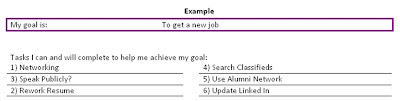
This is what your paper might look like, for example:
2. Set up a linear progression

With your list of possible tasks in front of you, go ahead and add numbers to them in the order that you would like to tackle them. (You'll notice this was already done in the example.) Be sure that they build on one another. For example, if one of your tasks is to run a mile, and another is to run in a 5k race, you’ll want to accomplish running a mile before running a 5k.

3. Break down tasks into actions

Then, once your list is in order, start by breaking down the first task into several actions. This process should repeat and repeat until you feel like you have a variety of actions that are of a manageable size.

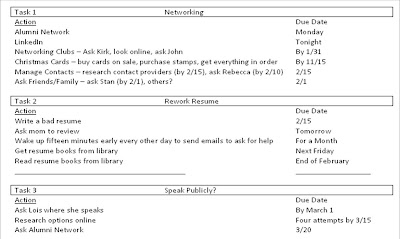
To demonstrate this, the example (above) is continued below. This person's goal is to get a new job. The possible tasks are listed underneath the goal, and "Network" was designated task number 1, "Rework Resume" task number 2, and "Speak Publicly?" task number 3.

You'll notice that some of the tasks are broad, brush-stroke kind of tasks, like "LinkedIn" or "Alumni Network," and some of them are more specific, like "Networking Clubs – Ask Kirk, look online, ask John." If you trust yourself to follow through on a bigger, slightly vaguer action, then you can leave that action unexpanded. But if you have any doubt about your willingness or ability to get something like that done, expand it.

So what do you do if you have an action you want to perform but don’t know how to do it? Break that task down into “Ask for Help” and then expand that into a list of people you can contact for help!

You'll notice on the example, too, that dates have been added. In adding these due dates, you'll want to keep Being Realistic in mind. Can you really write 500 pages by the end of the month? Can you commit to attending 5 networking events a week? Be gentle enough with yourself to avoid burnout, but challenging enough so that the effort of reaching your goal changes your day-to-day energy.

Each task and action should have a deadline for it. That said, the deadline can be “by next Friday,” “by March 1st,” or “by the end of the year.” As those deadlines approach, you’ll revisit the list of tasks and subtasks and update the deadlines.

You may notice that as you’re adding tasks and due dates that lots of emotions come up for you. Resistance, anger, fear, frustration, or just general discomfort. That’s because you’re making change. Achieving this goal is something you’ve wanted for some time, or you wouldn’t be going after it now. Just know that your challenge to the status quo is going to bring up some of these feelings.

And that’s totally ok! In fact, it’s good! A friend of mine used to say “if it’s uncomfortable, that’s good, it’s growth.”

These feelings are part of what we’ll be working on in the next post, so be sure to come back!

Friday, January 15, 2010

Resolutions to Results V: Get SMARTY!

So now that you've brainstormed some great ideas, you've prioritized those ideas, identified success, and visualized yourself achieving those goals, it’s time to get writing!

Writing out your goals makes it much more likely to achieve them. How much more likely? 900% (No, I'm kidding I made that up. I actually have no idea.) But from my personal experience, I can say that writing your goals down make them more real, more concrete, and therefore, more achievable.

(This doesn’t mean you can just write them and walk away, however!)

You've probably seen the goal-setting acronym "SMART" before. Lots of different people use these letters to mean lots of different things, and I think that, in general, any way you combine them they're right. The jist of all of them are the same.

However, I take SMART one step further, and encourage you to set goals for a SMARTY(pants), because it incorporates an element of goal setting that is missing from a lot of other approaches; the YES! factor.

Read on, dear reader, read on.

S: Keep it simple.
Your brain wants to remember as little as possible. Focus on the heart of what you want, and write it in the positive (not the negative -- like I'm doing here).

For example, if you want to stop biting your nails, phrase your goal as “I want to protect my nails from harm” or “I want to take care of my nails.” The reason I recommend this is that if you phrase a goal with a negative in it (quit smoking, stop overeating, stop dating losers), your brain remembers the positive – the smoking, the overeating, the dating losers. So give your brain a healthy, positive, SIMPLE thing on which to focus.

M: Make it Measurable
As we discussed in previous posts, if you can’t measure your success, you won’t know when you’ve achieved it. Avoid words like “more” and “better,” and instead focus on how much more? How much better?

A popular goal is to “get in shape.” What does that even mean? Walking a mile or running a marathon? Be specific! Giving yourself benchmarks to measure your progress will not only help you stay motivated, but it will make your goal setting more scientific and less ambiguous.

And ambiguous goals = kinda, sorta, maybe reachable ones.

A: Use Action Verbs
As good writers, actors, teachers, and others know, employing action verbs is critical. The same is true for writing goals. Using action verbs helps you create a goal that has movement behind it. So instead of setting a goal that is to “be more patient,” you can set one to “practice more patience.” It’s a subtle difference, but in those challenging moments, when you’re having a hard time sticking to your goals, having an action that you can perform (like “practice” instead of “be”) will help keep you on your path.

It may also open up other possibilities you haven’t considered. For example, if your goal is to “be in more shows,” if you rewrite it to “perform seven times this year,” that opens up the definition of “perform” and can help you see your goal in a new light.

If you have trouble coming up with action verbs, look here, here, or just google "action verbs."

R: Be Realistic (but challenging!)
"Realisitic" is not a synonym for "easy." Realistic, in this case, means actually doable, or attainable. You have the skills needed to do the work – or can develop them in the process. A realistic goal may push your abilities and knowledge, but it shouldn't break them.

A goal of never again eating sweets may not be realistic for someone who really enjoys candy. However, setting a goal of eating a piece of fruit each day instead of one chocolate is more realistic. You can then choose to work towards reducing the amount of candy gradually as and when this feels realistic for you.

Be sure to set goals that you can attain with some effort! Too difficult and you set the stage for the dreaded "failure," but too low sends your spirit the message that you aren't very capable. Set the bar high enough for a satisfying achievement!

T: Be Time-Bound
As we discussed while we were identifying success, set a timeframe for the goal: for next week, in three months, by your fortieth birthday. Putting an end point on your goal gives you a clear target to work towards, and helps you to break down the goal into chunks you can tackle one week, one month, and one year at a time.

If you don't set a deadline, the commitment is too vague and there's hardly any reason to start taking action now.

Also, be sure to give yourself enough time to reach the goal, but not so much time that you lose interest or motivation.

Y: Yes!! Thrill Yourself!
This is an element that is often left out of goal setting, and which is why you come to me! Be sure to pick a goal that excites, moves, and thrills you! I’ve said it before and I’ll say it again – if what you are trying to achieve is meant to please someone other than yourself, that goal is destined for failure. Find with WIIFM in the goal! And phrase it in such a way that it resonates with you and serves your values.

For example, “Lose weight” can become “lose 50 pounds by December so you can wear your skinny jeans next Christmas.”


Once you've come up with some goal statements, be brave -- add them to my comments! It will be one way to announce your commitment, and to share what you've learned with other readers!

Tuesday, January 12, 2010

Resolutions to Results IV: Visualizing Success

Visualizing Success

The power of visualization was tested in the early 1980s by Russian Olympic karate competitors. The coaches broke their athletes into four groups and gave them varying amounts of mental training (visualization) and physical training (workouts), and found that the groups who visualized the perfect execution of their karate moves actually fared better during competition than those who practiced them in the gym!*

So this speaks pretty powerfully to the value of visualization.

Go back to the previous post and take a few minutes to look over the answers you wrote to the questions about what the benefits are for you in achieving your goal. And one by one, try those benefits on, like items from your closet. See how they fit. And if you happen to hear a little voice inside your head saying things like "you can't have that" or "don't be ridiculous," thank that little voice, and tell it to sit on a peg.

Remind yourself, as you put on these benefits, that this is just an exercise. It's just practice, to see if these things feel good enough to motivate you to achieve your goal. And when you've got all these winning elements in place, look at yourself in the mirror, a proud doer of what it is you want to do. Can you see yourself in a place of success?

Grab a piece of paper and make some notes about this. What does it feel like to achieve your goals? Use juicy details – look, listen, taste, and smell what it will be like to reach your goals. Bring colors, sounds, music, flavors, and textures into your vision. But most importantly, feel it! Create a vision that makes you feel motivated, passionate and enthusiastic, and then revisit that as many times a day as you can.

How long should you spend visualizing your own success? As long as you want to. I recognize that we're all busy people, so I suggest starting with thirty seconds to a minute. Do it just after you've parked your car, or for the first 30 seconds on the subway train. Do it while you climb the stairs to your bedroom, or as you pee. Attach your visualization to something you do every day -- that way you'll remember to do it every day!

In the few minutes right before you go to sleep or right before you get out of bed your brain is more receptive to the messages you send it. So why not take half a minute while laying in that comfortable position… warm and cozy… to think about what you want? See yourself getting it. And look, if it doesn't get you to your goal, it will make waking less of a drag!

I have a coworker who is overweight. And he's lost over 150 pounds already, just by changing his diet (not even exercising). And part of what keeps him motivated is that when he looks in the mirror, he sees himself "looking buff." He imagines himself in a swimsuit, on the beach, with his kids proud to be around such a good looking guy. And EVERY time he looks at himself in a full body mirror, he does this.

Because it works.

So try it. Commit to it for a week and just see what happens. If it doesn't work for you, then at least you can cross it off your list of things to try having given it your best shot.


* See Karate of Okinawa: Building Warrior Spirit with Gan*Soku*Tanden*Riki by Robert Scaglione and William Cummins for more details.

Wednesday, January 6, 2010

Resolutions to Results III: Identifying Success

This is part three in an ongoing series of posts about setting (and reaching!) your goals this year. Part I (Brainstorming Goals) is here, and Part II (Prioritizing) is here. This post picks up where those two leave off.

Identifying the successful achievement of your goal is really important. If you don't know where you're going, how will you know when you've gotten there? In the course of the next two posts, I'll share with you some tools to use to identify a successful achievement of your goal.

1. Measurability

To identify success, your mind actually needs some numbers. If your goal is “to work more” this year, what does “more” mean? Is one show or published article enough? Or do you have to do six shows this year, or four published articles for it to count as “more”?

Similarly, if you want to lose weight, how much do you want to lose? “Some?” Or fifteen pounds? When you’ve lost a pound, are you halfway there, or are you one tenth of the way? It’s hard to stay motivated when the desired end results are vague. It’s also really easy to let yourself off the hook when you use “mushy” words to identify success.

Coming up with numbers helps you distribute the work that you’ll have to do over the course of a year. If you want to teach six classes this year, that’s one every other month, on average.

If you’re not sure how you want to define success, try picking something. Make it realistic -- not losing 100 pounds by Valentine’s day, or getting your demo produced tomorrow. But if you’re not sure what’s realistic, ask your friends and family. Ask someone else who's done what you're hoping to achieve. Or just pick something. If you don’t get there this year, then adjust for next year. If you get there too quickly this year, you can always add to your goal.

2. WIIFM -- What's In It For Me?

WIIFM is all about the benefits you’ll get when you achieve this goal. This is really the driving motivation behind going after this goal in the first place. You can start to answer this question by asking yourself the following questions: “What will I get when I’ve reached this goal?” “How will I feel?” “What will be different once I’ve achieved this goal?” “How will this achievement change my life?”

Answering these questions specifically and richly will help you to stay on target. For big challenges, you can post the answers to the WIIFM questions in areas of high visibility (the fridge, your screensaver, over the toilet). Remembering what you’ll gain from the achievement will help you in the moment-to-moment choice-making.

Join me in the next post for two more tools to help you identify success and point yourself more specifically in that direction.


And don't forget! There's still time to sign up for the Make It Happen Now! workshop that I'm offering on January 16th from 2-5 pm. Information and the sign up button can be found here.